Showing posts with label Kent Ridge Road. Show all posts

Saturday, February 4, 2012

Smilax mass flowering

This was quite a dated post, as it occurred about 3 weeks back. I learnt about how the nasty Simlax setosa can be: vigorous growth that smother and cover over trees and almost impossible to eradicate since they can regenerate themselves as separate individuals from their stem cuttings.

This is my first time seeing them flower. In fact, all these while, I thought that they propagate vegetatively. Apparently I was wrong!

IMG_7162

Because of its abundance, the mass flowering of it at Kent Ridge Road make it quite spectacular! Like little pom-poms, they look a little like Hoya or Uncaria as commented by A and WF.

Tuesday, December 27, 2011

I grew a mistletoe

As the title said, the mistletoe seed of Dendrophthoe pentandra which I placed on a Vitex pinnata tree germinated!

IMG_6964

Can you see the two small leaves coming out from the seed? :)

Merry Christmas!

Saturday, May 17, 2008

Ctenus floweri

On a grass patch along Kent Ridge road, one of the Japanese students, Misaki found a large unknown spider of 5cm during one of the biodiversity workshops. It was taken back and showed to the spider expert, David Court.


He identified this spider as probably Ctenus floweri, from the family Ctenidae. He explained that this spider is not commonly seen by people, but it is not rare, just that its habitat, among leaf litters is not of one that people will frequent. Spiders from the Ctenidae family hunts actively for food.


Photos taken by David Court

Monday, March 3, 2008

Cockatoo @ NUS

cockatoo Tanimbar corella

Heard the unmistakeable noisy chatter of a cockatoo just as I was preparing to walk back to the lab from Kent Ridge. The Tanimbar Corella (Cacatua goffini) together with the Sulphur-crested cockatoo which have been sighted frequently here are exotic, probably escapees from pet owners (Tanimbar Corellas are under CITES appendix I). From their name, the Tanimbar Corella is native and endemic to the Tanimbar islands in Indonesia.

tanimbar corella

To me, cockatoos are remarkable acrobats for their size, hanging at seemingly impossible angles to reach their food. Their beaks also seemed to act as a third limb, just like how some monkeys use their prehensile tails.

And so, as I kept photographing the bird, another flew over (above). Just as I inched closer for a perfect shot, three more rushed to get into the limelight. And just so great that my battery died on me at this moment... =.=

Wednesday, February 27, 2008

The Bird and the Spider


Was relaxing at Kent Ridge looking at birds, after diving when an Olive-Back Sunbird Cinnyris jugularis flew in front of me, just a 3 metres away. It hovered about before flying off and coming back again for three more times before I realised what was happening.


It was either attacking or kept bumping on the web of a golden orb spider, Nephila antipodiana. For a moment I thought that the bird might get entangled on the web. Dingli shared with me that Nephila spiders do prey on birds which unknowningly got trapped on their webs.

But I guess probably the former since it looks to me as if it was poking at the web. Although they feed mainly on nectar, part of their diet includes insects and the big Nephila might look like a relishing meal. Whatever the reason, it gave up what it was doing and flew off shortly.

Update~ Budak suggested that the sunbird might be collecting the spider silk to make its nest.

Also saw some new birds for me to tick off my checklist! Blue-tailed bee-eater, Asian brown flycatcher, Dollarbird.


Thanks Dingz and Budak for the input and ID

Friday, October 5, 2007

Flora in Kent Ridge

This is part of my geography module, which involves designing a poster on three plants in NUS. A pretty rush job and me, diana and justin worked till 3am to finished this! At least thats another project down and I survived this week of madness. Click on it to enlarge and enjoy!

Thanx for again for Wee Yeow Chin and Angie Ng for allowing me to use their photos on the mistletoe!

(Btw anyone know any free software that convert word or pdf to jpg format? my current one places an enormous watermark there...)


Supposed to have 4 pages that join to form a poster but I removed the first page, which include the map where the plants were located.

Justin: Pitcher plant
Me: Mistletoe
Diana: Smilax

Monday, May 28, 2007

Pitcher hunting

A short but interesting walk at NUS to hunt for some photo-friendly pitchers with KS. It wasnt that hard to find them as I was shown where they were during my ecology class and pretty abundant too. Pitcher plants are fascinating I'm sure to anyone, (I was so excited when shown by Lainie and Jinghui), being so cute and their carnivorous nature.

Pitcher plants are known in chinese as (zhu long cao) pige cage plants due to their shape resemblance to those pig cages of the past. Tropical pitcher plants (Old world pitchers) also have a cute name of monkey's cup as they had been seen quenching their thirst from this cup-shaped structure.


The adinandra belukar forest there is an acidic and low nutrient secondary forest. Pitcher plants can survive well in such places as they can obtain their nutrients through carnivory. Rem hearing from one lecturer that, the pitcher will not form if grown in well nourished soils.

Lotsa young ones on the ground

Nepenthes rafflesiana are very common here! Yup... it was named after our founder, Sir Stamford Raffles. In fact, as I was browsing, there were quite a number of flora and fauna named in honour of him. Apparently besides making here a busy port, he was also a biology enthusiast.


The parasitic flowering plants had also a whole genus named after him! The biggest individual flower in the world, Rafflesia arnoldii was also within the group. As shown above, adventurous Dingli taking a picture with the rare plant. Wonder hows hes doing over at Borneo? nw.

Tendrils of the pitchers (of tropical pitchers) will eventually grow into the pitcher trap, so the structure is actually a modified leaf.

Half rotten upper pitcher. Learnt from Ron and Budak that the plant actually have two differing pitchers. The upper pitcher of N. rafflesiana is thinner and slender. This is to trap winged insects or animals attracted to their nectary lure.

The lower pitchers of the N. rafflesiana are fatter and larger in size, often resting on the ground. It also have characteristic "wings" at the front, which is thought to serve as a guide for crawling insects leading to the nectar. The nectaries are located mainly along the "lips" (peristome) and underside of the "roof" of the pitcher.

They capture their prey by a pitfall trap, with slippery sides & grooves / hairs arranged so they cant climb back up. Eventually they will drown and be digested in the liquid present within the cavity.

N. rafflesiana has quite a few varieties and their pitcher size varies too, which can grow to a very large size, a record of 35cm. The largest species is N. rajah which is endemic in Mt. Kinabalu.

Each pitcher plant is either male or female bearing raceme (arranged vertically) infloresences. Right showing the inflorescene (duno their sex) and left the fruits?


There was another species of pitcher plant there, possibly the lower pitcher of N. gracilis. This was more interesting as it was so small that it took us awhile squirming our eyes to spot them. A 50 cent coin was placed for scale.


Macro view showing clearly the "wings".

More interesting and informative entries on pitchers
1) Budak
2) Earth
3) Nparks

Lastly... no poaching pls!

Saturday, December 23, 2006

Kent Ridge Road walk

Staying at home for the past 2 days really makes me think of alot of negative things. Some things were just not the same again. Haiz... Anyway, some sunshine finally showed out today so I went out for some exploring again. I went into this restricted forested land near NUS (yes, I trespassed again) to see if there’s any interesting stuff inside. Definitely very wild place in there with lots of creepy crawlies. Although there’s a trail present, I kept walking into thick strings of cobwebs. But I saw one large black bird the size of a hen. Not sure what bird it was, will consult dingli when he’s back from KL. However, I was quickly turned off by those nasty mosquitoes. In just 20mins I have 15 bites all over my arm! The last straw was when an insect flew and smack right on my cheek. Gee :S I quickly turned back and walked to NUS. But think there’s much to be discovered there. Will go back next time with some insect repellent.


A nice view was this plant inflorescence of the plant Leena indica, which attracted many of these yellow butterflies and some flies and wasps.
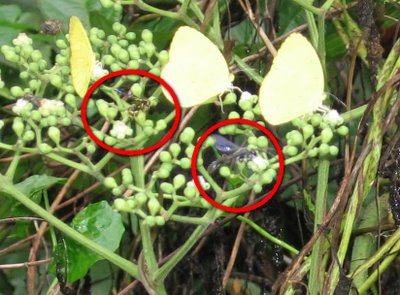

Enlarged picture. A black wasp and a yellow jacket (left circle, body with yellow strips)? A tiny black fly on the extreme left centre.

Back at NUS, I found this orchid with beautiful white flowers on a tree. I had been suspecting that those epiphytes were orchid plants and today finally confirmed it after seeing the flowers. Its pretty surprising for me that there are actually wild orchids in abundance all around. A check on the net actually reveals that it is the most common orchid in Singapore =_=''. It was said that many of them were planted intentionally by authorities to encourage their growth. Also they bloomed when there was a sudden drop in temperature of at least 5.5oC (remembered Prof Loh saying that). All this raining probably cos their blooming now. Anyway, I went to LSlab2, thought of saying hi to Mrs Ang but sadly she was on leave. But I took some Helianthus annus seeds from another lab tech for girl who want to grow them.
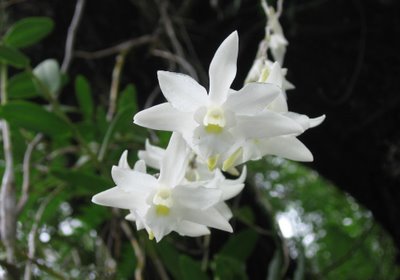

Pigeon orchids, Dendrobium crumenatum on a tree near science canteen

It was still early so I thought of taking a walk at Kent Ridge Road, where I visited during one of the Biodiversity lab sessions two years back. It turned out to be a rather pleasant walk.
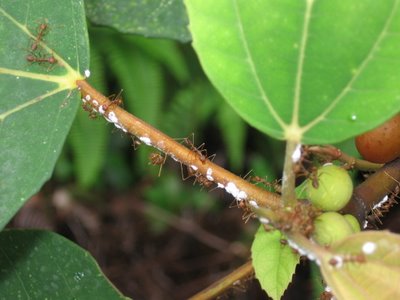

Red ants harvesting from scale insects

There was this clearing where there was a great view of the forest till King Edward hall and Pasir Panjang wharves. It was here that I heard the crowing of a cockatoo and found it perched high up a tree. Three swallows were also gliding in the sky like tiny aeroplanes. A pink-necked green pigeon came flying on the canopy of another nearby tree. This is my first time seeing it and the its colorful plumage is really amazing. Walking down the road, there was a sudden disturbance at the trees and I saw another large bird in brown and black streaks flew quickly past. Wow...can't catch much of it so dun think can identify.
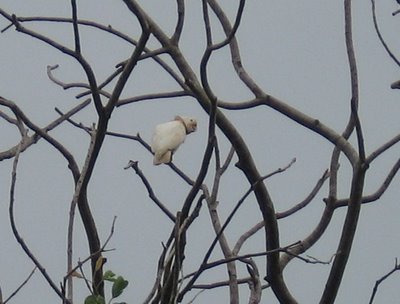

An Tanimbar Corella (cockatoo), Cacatua goffiniana
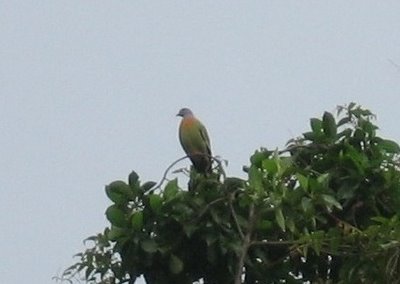
Pink necked green pigeon, Treron vernans
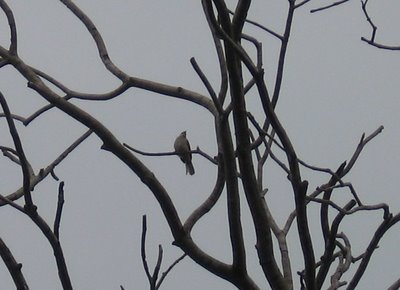

Another unidentified bird

There was a pathway leading down to the Medical blocks and at the medical garden, I found out that there were actually mistletoes growing on the weeping willow.
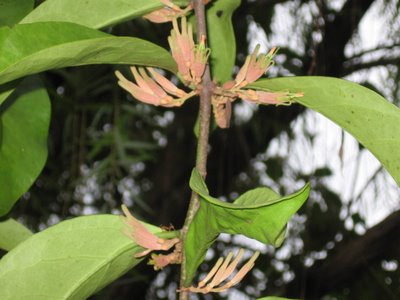

inflorescence on a mistletoe growing on weeping willow

An intial wasted trip to the state land turns out to be not bad at Kent Ridge road instead. At least my mood improved slightly after this trip.

Related Posts Plugin for WordPress, Blogger...