Showing posts with label Sungei Serangoon. Show all posts

Sunday, September 27, 2009

Mangroves from Punggol to Serangoon

After work yesterday, I decided to head down to ground truth some mangroves around my area for my friend. I engaged my dad’s help to drive me straight down to Punggol Beach before heading back using my bicycle.

IMGP2807

Large patches of the wasteland here are being cleared in the vicinity.

IMGP2811

There is a really super tiny mangrove near the beach. Unfortunately, I did not check the tide and it was rather high then.

IMGP2814

There were lots of mudskippers at the drain linking to the mangrove. I am not particularly good at identifying these fishes, but they look a little like the dusty-gilled mudskippers (Periophthalmus novemradiatus). Please correct me if I am wrong.

IMGP2821 
Lots of Ellobium snails (Cassidula sp.) on a low stem of sea hibiscus.

IMGP2829 
A tree climbing crab retreating into a hole. However, this is not the tunnel of a mud lobster mound but rather, one from the concrete drains!
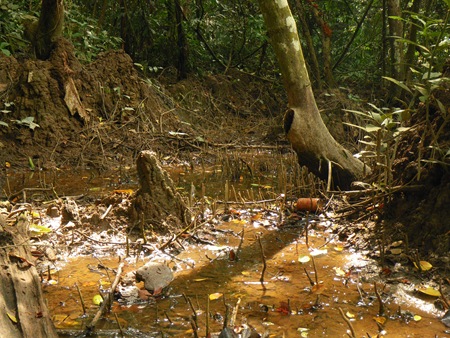
IMGP2834

At the opposite side of the road, there were also some remnant of a mangrove. Api-Api (Avicennia sp.) needle roots poked out of the stagnant water-logged mud.

IMGP2832 
A huge clump of mud lobster mound stood at the centre with sea hollies (Acanthus sp.) over growing it.

IMGP2835  
I also caught sight of some beautiful orange fungus.

IMGP2868

Next, I cycled over to Sungei Serangoon. The dam is already being constructed and this, together with Sungei Punggol will be our next two up-coming reservoirs.

IMGP2872

I spotted a small water body leading into this Acacia auriculiformis dominated forest filled with Asystasia gangetica undergrowth and thought some mangroves might be hiding inside. Hence I made a decision to bash in.

IMGP2876
 
Here is the reddish stream that is probably covered with tannin from the fallen leaves; but no mangroves. I wonder what life is present inside.

IMGP2878
 
A Lampin budak (Claoxylon indicum) plant. The leaves of this native plant is used by the Malays previously as diapers for their babies.

IMGP2881

And lastly, a view from Buankok Bridge of the mangroves with Sengkang estate at the background. Though it looks pretty lush, but it is just a thin strip along the embankment. With the dam being completed soon, this entire river will be dammed up and will convert into a freshwater body eventually. What will happen to the mangroves?

Wednesday, May 13, 2009

Serangoon mangroves II

Having found a more accessible route, I'm back at Sungei Serangoon again. It's great to have a mangrove habitat so near my home for a quick exploration.

IMG_4458
Here is another view of the mangrove overlooking Seng Kang.

IMGP1613
Besides the plants shown during my last trip, here are some new ones. Nothing special but good for a revision. Here is the emerging propagule of Bruguiera cylindrica.

IMG_4479
I only saw two Mangrove apple, Sonneratia alba throughout the walk.

IMGP1605
There was a healthy patch of Acanthus sp. that were all fruiting. They were commonly known as Sea hollies due to their spiny leaves similar to the Christmas holly plant. However, not all of them possess it and some of them ahve spines in varying degrees.

IMGP1603
The Noni plant, Morinda citrifolia, has fruits that are a favourite for weaver ants, probably because it secretes some sugary fluid from there. Unfortunately, I was unable to find one for a picture.

IMG_4490
I was fortunate to see the beautiful flowers of the sea hibiscus, Hibiscus tiliaceus. These flowers only last for a day and they will turn orange before dropping off.

IMGP1630
Perhaps I had not been that attentive previously but this is the first time I am seeing this snail, Dostia sp.

IMGP1624
There were lots of Juda's Ear Ellobium, Ellobium aurisjudae, slithering all over a decaying stump probably feeding on algae or detritus covering over the dead tree.

IMGP1642
There were lots of crabs under the bridge at the mudflat picking at the nutrient rich mud. It was really hard to take this picture having to wait impatiently under the hot sorching sun. Could this be Uca triangularis on its raised burrow?

IMG_4472
The colourful porcelain fiddler crab, Uca annulipes, was probably the more common species around.

IMG_4478
The largest mudskipper in Singapore is the Giant Mudskipper, Periophthalmodon schlosseri, which was also present here.

IMG_4465
And lastly, the empty shells of the edible Lokan, Geloina sp. were spilled all over the mud together with the unsightly rubbish.

Only took about an hour to explore this area as I had to head back home for lunch. But will probably be back again soon since its just a 10min cycle from my home~

Friday, May 8, 2009

Walk at Sungei Serangoon mangroves

Feeling bored today, I decided to cycle to a patch of mangroves along Serangoon reservoir.

IMGP1533
In order to reach there, I had ride along TPE and went underneath the bridge. It was pretty eerie exploring alone and also seemed like an ideal place for illegal immigrants to hide in.

IMGP1534
Lots of Tamil scribings at the bridge. There were also a lot of wasp nests overhanging from here. >Update: They are Thai instead of Tamil.

IMG_4358
There was a juvenile Malayan water monitor lizard (Varanus salvator) swimming in the river. These lizards can be found at all sorts of water ways, even at canals and beaches.


Peeping down in the water, I can see barnacles extending out their hairy legs to feed. From the video, it was interesting to see that they can actually move their legs around to "grab" and filter food in different directions. Besides these crustaceans, there were also some tubes whereby worm like animals were snaking out from. I wonder what are those?

IMG_4384
This is the part where I was itching to explore. A small stretch of mangrove just at the doorstep of Seng Kang housing estate. Some construction work were ongoing but it seemed that they are not going to clear the mangroves but just the land after that.

IMG_4378
Avicennia alba or Api-Api Putih is the most common plant here. It can be easily identified by the tapering leaves and white underside.

IMGP1542
There were also lots of climbers, Clerodendron inerme and all of them were fruiting.

IMGP1548
Here was another climber, the sea derris (Derris trifoliata). The sap contains toxin which is used as a fish poison and can be destroyed through cooking.

IMG_4368
Buta-buta (Excoecaria agallocha) or blind your eyes is another plant which has poisonous sap that can blind one's eyes. Excess salt absorbed from the seawater can actually be transported to old leaves which are shed periodically.

IMG_4376
The only fern species found in a mangrove habitat are the mangrove ferns. This is Acrostichum aureum and the fertile fronds containing the spores are spread all over the leaves at the end, thus appearing brownish.

IMG_4380
Katydids (Family: Tettigoniidae) are closely related to grasshopper, thus also earning the common name; long horned grasshopper. This was sitting on another api api, A. rumphiana.

IMGP1550
This little snail is called a perwinkle, Littoraria sp. Did it made those holes on the leaves?

IMGP1544
Besides herbivores, I also managed to find a predator. A praying mantis (Order: Mantodea) nymph was waiting patiently on the leaf waiting for a careless prey to stumble by it.

IMGP1554
One more interesting discovering was this fresh carcass. I wonder what species of snake this was... Update: Thanks to Ivan for the ID, this snake is a house wolf snake (Lycodon capucinus).

I would have like to carry on walking to the end of the mangrove but unfortunately, I was not dressed appropriately for this trip (in singlet and sandels). After getting cut by the sharp barnacles, I decided to head back. Did not manage to see a variety of species here but I did not explore much and it seemed more diverse at the opposite bank. Have to find a better route to come here though! It was pretty terrifying to cycle on an expressway~

Saturday, February 23, 2008

Flower picking

Woke up early on Sat morning, (ok, maybe 9am is not early to some ;p) so decided to go cycle around the neighbourhood. Took my camera along in hope that I can get some nice pictures along Sungei Serangoon.

Indeed I wasn't disappointed, many birds are up early too, saw the little egrets, sandpipers, purple herons, great herons etc. Many others, I'm sure, are hiding somewhere from my view.


Got a great view of the Grey Heron perching on a small tree, preening itself in the sun. Somehow, for no reason, at least to me, it started to flapped it wings about...


And start harvesting those morning glory flowers around it! lol, is it for a special someone?


Heres one in its mouth.


And another. I wonder why its doing it. It appears to be getting rid of those flowers. Any suggestions?

Sunday, July 8, 2007

A lazy Sunday afternoon

Was feeling pretty bored staying at home so thought of just do a short biking trip around the vicinity. Thought of going to recee the part where TPE intercepts Sungei Serangoon. Anyway, am on leave from army this weekend =)

Wasn't a good day to start, with dark clouds gathering nearby.

A drift net placed over a bridge...


Was riding along TPE when these 2 fellows caught my eye. Thanx to Shun deng, these are probably two male white-headed munia. They feed on grass seeds as seen above.


Hard to get a good picture with all those grass blades blocking. grr...


Gloomy skies... This bald tree has several birds roosting on it.


Yupz, they are pigeons.


Lastly, saw this bird hovering in the sky near me, probably battling with the strong wind. Did not had a clear view of it but it was pretty big, prob a raptor. Anyone can ID with just this picture? Alas, it flew off just as I took out my camera to get a decent picture.

Was forced to turn back before I found sungei serangoon as raindrops fall. Will be back the next occasion, which will prob be 2 weeks later. A short trip, but nevertheless, as long as I learn a new ID each trip, I be happy lao =)

Saturday, December 30, 2006

Sungei Serangoon #2

Today went to the other side of Sungei Serangoon. Saw the usual suspects, little and great egrets, black-naped orioles, yellow-vented bulbuls and quite a few white-breasted waterhens which ran quickly into the bushes when they saw me. Of cos, I guessed they were more birds in the vicinity but I was too amateurish to identify anything. =p


looking at the gentle water current always seems so relaxing to me

Nursery of tiny fishes

The river was soon blocked by the trees so there wasn't much to see. I soon reached Sengkang, where the familiar fishing spot where Mervyn showed me last time was under some construction, a road I think, to connect to the opposite bank.


There was this photographer taking pictures of birds using his gigantic camera. For me, I couldn’t possibly do that using my own tiny camera. Instead, I climbed down the sloping riprap to see if theres any stuff to observe. That’s when I saw this lovely sight.

Scooping motions of the barnacles feathery legs to filter feed. Heres another video I took showing more clearly the scooping but more blurry.

Closed "mouth" of the barnacles

Barnacles filter feeding! This is the first time I saw this. Still remembered our TA Ngan Kee told us the comical way they filter feed. Indeed, it was quite cute. Barnacles belonged to the phylum arthropods and sub-phylum Crusteceans. Thus they are more closely related to shrimps rather than the common misconception that they are bivalves of phylum Mollusks. Some more facts from wildsingapore, Chek Jawa guide. The larvae are shrimp-like and able to swim freely till they found a spot to attach themselves head down to a hard surface and develop a hard shell over it. They are usually hermaphrodites but they do not self-fertilize. Instead they have a tremendously long penis to reach and fertilize neighboring barnacles.

Related Posts Plugin for WordPress, Blogger...