Showing posts with label Sungei Buloh. Show all posts

Sunday, September 13, 2009

Crocodile!

At long last! After so many trips to Sungei Buloh, I managed to tap on RY’s luck and finally get to see the Estuarine Crocodile (Crocodylus porosus)! 
 IMG_5056

It was basking on the across the bank from the platform where we were. It seemed like quite a small one but RY said it is because of the distance. This species is the largest of all living reptiles today. I hope the public who visit this place will also feel the awe that I felt rather than fear, followed by complains and ultimately, the removal of it to a crocodile farm and ending up as a purse as what had happened previously.

This is a nature area and we should we be proud that we have such amazing animals in Singapore.

Guided walk at Sungei Buloh Wetland Reserve

I woke up early today hoping to do a recee before my walk at SBWR. The weather looked perfect when I waited at the bus interchange, or so I thought. Evi sent me an SMS about “raining giant lizards” in the west, followed by SF about thunderbolts striking in her area and lastly from Mel in the East.

IMG_4946

I decided to go ahead despite the weather-women warnings since it was not raining in the north. However, I got more worried about my decision as dark clouds gathered gradually. My heart went down when it started to pour just when I reached Buloh.

What a relief, as with just all my previous trips, the rain stopped in pretty soon! Though we started half an hour late, all of us were in a jovial mood. For me especially, phew…!

IMG_5094

It was low tide at this time and animals come out to play… this phrase got entrenched in my mind after watching the video show at SBWR so many times. The Tree Climbing Crabs were down at the mudflats feeding. During high tide, these crabs will climb up the trees to escape from predators that sweep in with the tide.

IMG_4950

A favourite site for juvenile Mangrove Horseshoe Crabs (Carcinoscorpius rotundicauda), we only managed to find a tiny one at the stream. This species is known to be very poisonous and people have died eating it in Thailand where it is a delicacy.

IMG_4915

The largest mudskipper in Singapore, the Giant Mudskipper (Periophthalmodon schlosser) has a voracious diet and is even known to eat other mudskippers!

IMG_4916

The Nipah Palm (Nypa fruticans) are bearing fruits! Do you know that encased within each of them is an attap chee?

IMG_5092

Due to the muddy nature of mangrove habitat, the substrate is perpetually waterlogged and soft. Many mangrove trees have found a way to overcome this obstacles. For example, the Api-Api (Avicennia sp.) have needle roots poking out of the mud like snorkels to breath air.

IMG_5044 
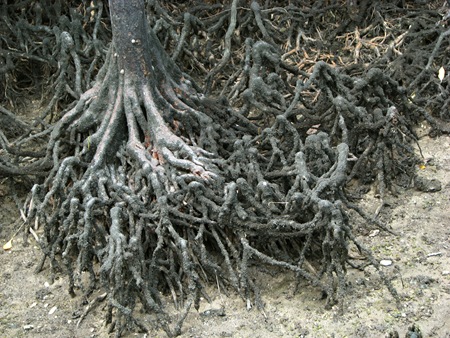
Bakau (Rhizophora sp.) on the other hand, possesses prop roots that provide a strong foothold on the mud.
 IMG_5132 
The next charismatic root form is found in the Bruguiera sp. They have have roots that bend upwards then down with the knobs resembling the knee caps of a person; hence the name knee roots. These “knees” pop out of the mud just like the Api-Api to gasp on air.
 20090906-IMG_0344

After finishing the boardwalk, as it was already 10am, I decided to bring my group to watch the video show first before heading to the main bridge.

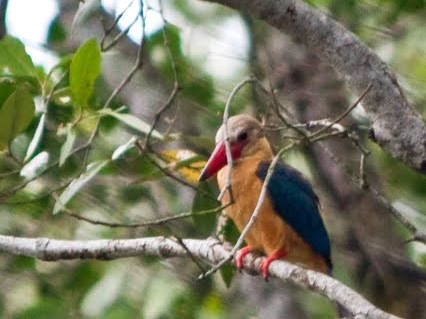
A Stork Billed Kingfisher (Pelargopsis capensis)was perching at its favourite spot and we admired some photos from a bird-photographer who took some amazing shots of it.

IMG_5075

The migratory birds are here! At the main hide, we found a Malayan Water Monitor Lizard walking among a group of Pacific Golden Plovers (Pluvialis fulva). One of the staff who was doing a survey there shared with us that the lizard can spot for any injured birds and grasp the opportunity to kill it; but not when they were all healthy and alert.
20090906-IMG_0391

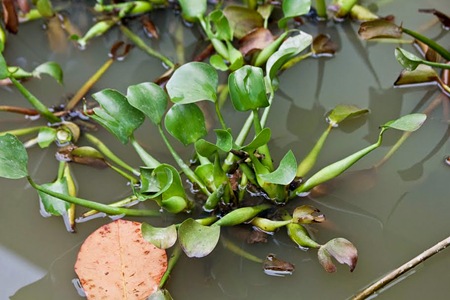
On the freshwater pond, the Water Hyacinth (Eichhornia crassipes) is a reminder of the invasive nature of this exotic weed. Just at the nearby Kranji Reservoir, a population explosion occurred in 1975 and filled the entire water surface with it.
  IMG_5039 
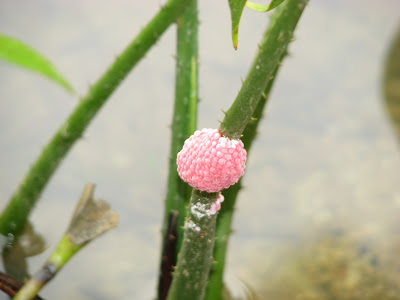
These pink clumps are egg masses of the Giant Apple Snail (Pomacea sp.). This is an invasive species native of America that is probably introduced through the aquarium trade.

20090906-IMG_0401

Lastly, a group photo of my group, the old gang together with some of their friends. Nice to catch up with everyone again. :)

Thanks to Sean for the awesome photos of the stork billed kingfisher, water hyacinth and group shot.

Saturday, May 23, 2009

School walk at Sungei Buloh

Seems like this is another posting about mangroves again. Anyway, we were back at Sungei Buloh today for another guided walk for two schools, Queensway and Fairfield. Here are some of the interesting stuff that we saw today.

IMG_4505
The Mangrove Cannonball (Xylocarpus granatum) is so named due to its big rounded fruits as seen here. As with most plants in this habitat, they are dispersed by water, whereby the fruit will split into several buoyant angular seeds after falling onto the ground.

IMG_4504
Slightly ahead, there were several Mangrove Horseshoe Crabs (Carcinoscorpius rotundicauda) creeping on the mud. These creatures actually have blue blood! This is because they possess copper instead of iron in their oxygen carrying protein, known as haemocyanin.

IMG_4499
Nipah Palm (Nypa fructicans) is a plant that everyone can relate to since most of us like to eat ice-kacang. The whitish gelatinous stuff beneath the ice, attap chee actually comes from the seeds of this palm.

IMGP1679
Beccari's Tent Spider (Cyrtophora beccarii) builds a 3D web with a dome shaped tent structure inside. The spider normally hides inside the tip of the tent, which is a silk tube and that is also the place where the egg sacs were kept.

IMGP1677
While passing by one of the mangrove trees, I spotted an animal running into the tree cavity. From the fleeting glimpse before it ran inside, it seemed like a juvenile monitor lizard. You can actually see the eyes peeping out from the hole.

IMG_4507
Here is another view of an adult Malayan Water Monior Lizard (Varanus salvator) which gave RY quite a scare. ;p

IMG_4496
There were many curious circular engravings on the bark of this dead Buta Buta plant (Exoecaria agallocha). These markings were actually drilled by the Mangrove Longhorn Beetle (Aeolesthes holosericeus) and it is said that they can be found in large numbers under them.

IMG_4493
At the main bridge, RY spotted another horseshoe, probably a Coastal Horseshoe Crab (Tachypleus gigas) which can be differentiate from the other by its angular shaped tail.

IMG_4508
There were several keen-eyed students that spotted three Common Greenback Frog (Rana erythraea) in the freshwater pond.

IMG_4509
It is always fun to guide a group of enthusiastic participants anytime!

But spending a whole hot day out here guiding is taking a toll on me now. Having a sore throat and slight fever currently. =S

Friday, March 13, 2009

Otters and more sightings at Sungei Buloh

Spent almost an entire week at Sungei Buloh guiding students at this nature reserve. Even though we did not managed to see a crocodile, but we were still rewarded with many other exciting discoveries to compensate for it.

IMG_4022
The best sightings are of course the smooth sea otters (Lutrogale perspicillata). This one popped its head out of the water cautiously after I stepped on a branch when I was inching closer to get a clearer shot.

IMG_4024
And I saw 4...

IMG_4028
No, 6 of them swimming and walking up the opposite bank!

IMG_3999
The second most exciting was seeing this paradise tree snake (Chrysopelea paradisi). As if this was not enough, it also performed for us by gliding to another tree!

IMG_4031
I also managed to see a juvenile Malayan Water Monitor Lizard hunting, it managed to catch and gulp up a mudskipper at the mudflats before scrambling to a Bakau tree, probably to get some vinegar crabs for dessert.

IMG_4032
Mangroves are an important food source for humans, and one of them is the favourite food for many, the chilli crabs (Scylla sp.)!

IMG_4033
Even though it was drizzling miserably today (besides being Friday the 13th), we still saw two mangrove whiprays (Himantura walga). They are armed with one or two venmonous stingers that can deliver a painful wound if threaten.

Obelisk posture
Besides the mangroves, there were also several ponds with lots of beautiful dragonflies. This one is assuming an obelisk posture believed to reduce the body's exposure to the afternoon sun's heat.

IMG_4034
And we ended the walk with some long-tailed macaque (Macaca fascicularis), sitting on the roof of the nature gallery.

Saturday, December 15, 2007

Kranji Trail and Sungei Buloh Walk

Nearly couldnt wakeup today as I was so tired! Thanx to Juan for inviting me to join the trip and CH for organising. Tidechaser, Mantamola, July was also here. Also finally had the chance meet JT, thanks for the drive to Buloh and back :)

We first walked into the Kranji trail. My chosen attire of 3/4 and sandals proved to be a big mistake. Ended up getting bitten all over by red ants...

Basically, today is a day of macro shootings:

A spiny spider, possibly Gasteracactha hasseltii.

A beautiful butterfly with 5 eyes. Waiting for July, the butterfly enthusiast to ID :)

There were many tiny snails and slugs crawling among the leaf blades.

I was mesmerized by this mangrove big-jawed spider! Look at its colorful back...

and front!

Candid shot of the ramblers

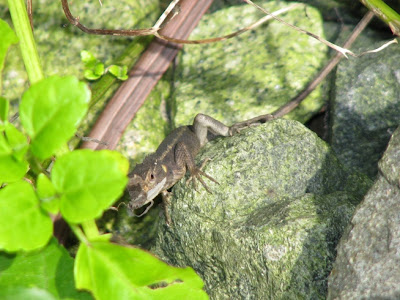
We were puzzling what species of lizard this is. But probably a changeable lizard looking at previous photos.

Before ending the trail, a robber fly perching motionlessly for a great shot. Robber flies feed on other flies and insects by injecting digestive enzymes into their victims and sucking up their juices.

And on the Sungei Buloh boardwalk:

An altas moth (Attacus atlas) just sitting next to the board walk! I kinda like moths over butterflies as they are easier to photograph ^^ and they have their wings spread when at rest. They also have super nice and bizzare wings patterns! For the altas moths, they are so named as their wings resembled maps. And they also have the largest wing area among all moths!

Isn't this adorable? A spider carrying its egg sac. Possibly a huntsman spider (family Sparassidae) as suggested by my friend.


This is perhaps the one that generate the most excitement. Jumping spiders (family Salticidae) is the largest family of spiders with over 500 genera and 5000 species. They are active hunters that doesn't spin a web and of cos the most distinguishing feature is that they jump! They also have excellent vision, even able to see UV light! In fact Dr Li Daiqin, the spider expert in NUS had published quite a few papers on the purpose of UV light on these jumping fellows.

This was the first time I seen such a big jumping spider. This was about twice the size of what I seen commonly. Anyway, we were all trying to take pictures of it but it kept jumping on each other's cameras, think only manta's camera din kena. Later after we finished, I din noticed that it had hitched a ride on my back till someone saw it on the next shelter. And all were happily snapping away on my back after that after telling me to freeze there! poor me...


A ton of waders on the mudflats in the abandoned prawn pond.


This was also an interesting sight. A monitor lizard den, or tunnel (not v visible here). Tidechaser and manta had just seen another monitor slipped into before this too.


Pretty pink eggs of the apple snail deposited on the water hyacinth.

Its been quite awhile since I been out on a leisure walk. Nice day out in the sun and basking with nature. =)

Wednesday, July 4, 2007

Monitor feeding

Heres some pictures of the Malayan water monitor feeding on a fish it caught. Taken during today's guiding trip @ Sungei Buloh. Turned out to be a nice trip today, cos we were more prepared compared to our BT nightmare field trip =) Enjoy! Go pack my stuff for army lao~~


Related Posts Plugin for WordPress, Blogger...