Showing posts with label NUS. Show all posts

Tuesday, June 19, 2012

Fledgling Pacific Swallows

It is tough being a baby swallow. One have to share the tiny space that is seemingly half the size of a typical nest since it was pasted to a wall. It must suck to be born as a claustrophobic swallow.

2

Even emptying the bowels is a tricky affair. I saw the middle baby shown above pushing its siblings gently so that it can turn around and drop the poop down to the ground. It then squeezed to make room so that it can turned itself around again.

1

I have been observing this nest in the National University of Singapore since 2007 in my previous blog post. Every year I will see little chicks sitting here till now. I wonder if they do nest maintenance once in a while?

Saturday, November 19, 2011

Do they really need to cut them down?

I was astonished (while retaining my usual bland expression) when A came back to the lab carrying a branch of Viscum ovalifolium, saying that some workers were pruning the Cratoxylum cochinchinense tree downstairs, and that he had took one of this mistletoe was had been removed from the tree.

Yup, Viscum ovalifolium is a mistletoe. They are semi-parasites, meaning that they penetrate their ‘roots’ into the host tree into their phloem only to absorb water and minerals from there. However, it can still photosynthesize and produce sugars by themselves, evident from their chlorophyll rich green leaves.

IMG_0461

While I am happy to examine the specimen close up for once, I am unhappy to find out that all the remaining mistletoe was totally eradicated from its host tree the next day. The host tree was doing fine even with this semi-parasitic mistletoe leeching on it for many years.

The author of the new book on Singapore’s mistletoes, Francis Lim wrote that this species is ‘by no means common’. Indeed, this is probably the only locality that I have seen it. Its national status is common though, and that probably needs some updating.

IMG_0462

Hope I am not sounding like a mindless tree hugger, especially after my recent complaint of tree cutting in the ST forum! I will probably apply mindless to those people who ordered these cutting/pruning actions instead. I am currently suffering now with glaring sunlight shining on my study table. I ache for the tree that has provided me ample shade for the past 20 years…

Monday, July 19, 2010

Spotted wood owl

Got alerted by SD that DL and friends have seen a pair of spotted wood owl (Strix seloputo) nearby just after work. This species is supposed to be a rare resident, which according to the annotated checklist of the birds of Singapore, only have a population of 6-10.

IMG_0078
I tagged along to have a look and they are really very cute! I was pretty amused to see one with the belly facing me but the head totally twisted 180 degree backwards. Soon, it turned back to face us and its eye-balls are damn huge~ :s

Interesting sighting~

Friday, May 28, 2010

Baby swallows in NUS

The swallows at DBS have new babies again! I have been watching out for them every since they started to build a new nest near their old fallen ones. However I can’t be sure whether the parents are the same birds as last time.

 
A pity that I only notice them when they fledged. Perhaps when they were younger, they probably can’t poke their heads out of the nest to beg for food. Hopefully they are still there next week for me to bring a better camera to snap nicer shots~

Wednesday, January 20, 2010

More Grasses and Sedges

I find it quite cool that I can appreciate those once boring lawn plants now. Imagine, they are basically found everywhere and I can be easily satisfied basically anywhere! LOL~ 

 
St. Augustine Grass, Stenotaphrum secundatum is an exotic plant that seldom flowers but spreads vegetatively.


KY is right when he said that I should learn the vegetative portions for ID-ing since they don’t always flower. But I guess I can take it slowly. Moreover, taking pictures of their inflorescences satisfy my thirst for macro photography. This is the inflorescence of the Seashore Centipede Grass, Ischaemum muticum.


There were lots of these sedges popping out from the carpark in NUS. CK said that they look like Fimbristylis sp. Not sure about their exact species though. There were some insects on the spikelets. I wonder if they are pollinators of these plants.

Here is a wasp with a big head on the sedge.

Wednesday, December 23, 2009

Little bugs in the lab

Another short post for everyone since I have not been out on any field trips recently.

The lab that I am in seems to be a rehabilitation centre for rearing small insects.

4207567943_de1c3cca42_b
Little hemiptera bugs belonging to the Green Stink Bug (Plautia affinis) just hatched from the cup shaped eggs. The eggs actually have a little lid which serves as the opening for the babies to emerge.

4207569117_92c3fda49b_b
An astonishing surprise to everyone when we saw this amazing golden chrysalis belonging to the Striped Blue Crow butterfly, Euploea mulciber mulciber. This is said to be a warning colouration since the caterpillar feeds on poisonous leaves.

Friday, November 20, 2009

Wasp nest in DBS

A beautiful large wasp has made its home above the door of one of the biology labs. For the safety for the wasp baby living inside, I won’t say which lab, though its pretty obvious from the background that there can only be two possible labs for those who work here.

Thanks to John, this wasp is a potter wasp, Phimenes flavopictus.

It was probably eating its larvae baby within the potter. Being so big and scary, I ran away when it seemingly flew towards me threatening. Still, its nice to know another animal.

Thursday, September 10, 2009

Seeing Red

WF showed me some Lime Butterfly (Papilio demoleus malayanus) caterpillars that he was rearing. The caterpillar looked like this below.

IMGP2604

However, when it became pissed, two bright red tongue-like organ everted out from the head.

IMGP2620

It turned out that the forked “tongue” is an organ called Osmetrium. It is said that it emits some smelly chenicals known as terpene that serves to repel predators. No kidding, this caterpillar even reeled its head up and over trying to strike me when I touched its buttocks!

Friday, August 14, 2009

“I Polunin” Exhibition

Today I decided to make an impromptu trip down to Centre for the Arts Museum with SD to visit the exhibition of Dr Ivan Polunin’s treasured collections of film, photos and other documents.

Dr Polunin has the largest collection of documentary footage of Singapore filmed between 1950 and 1970s, way before I was born.
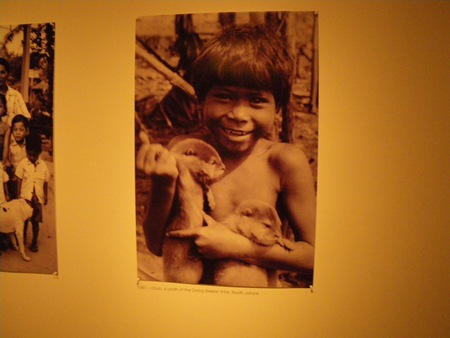
IMGP2453 
A boy holding two sea otters!

IMGP2457 
A past-time of the coastal community, sailing competition using this vessel called a Jong.

IMGP2458

Here is an abstract of Dr Polunin’s thoughts about this boat. Apparently these boats were made of Pulai (Alstonia augustiloba) due to its light wood.
IMGP2460
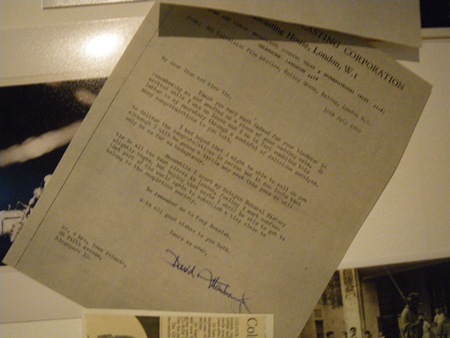
On one of the walls were a mosaic of documents. SD pointed out two letters addressed to Dr Polunin from Sir David Attenborough, the famous nature broadcaster!

There were also other interesting documents penned by Dr Polunin about mangroves, coconuts, fireflies and other medical information (he was a doctor by profession) pinned on the wall. It is a pity that I can’t take them down from the wall to read!
IMGP2470

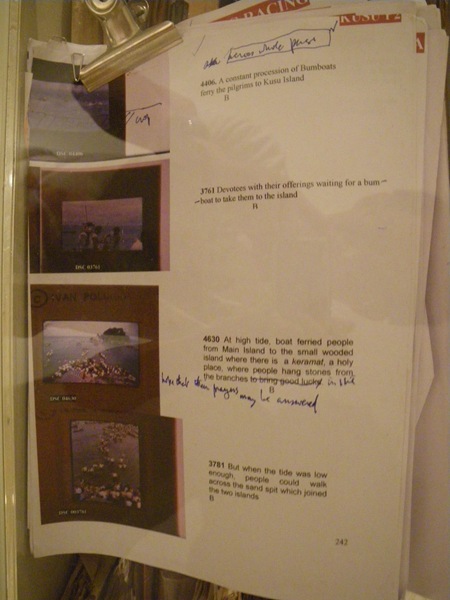
Within the few glass cabinets in the middle of the room, there were also many old literature scattered untidily (or artistically, depending on how you see it) inside. I was fascinated by this paper about Kusu Island. It mentioned that during low tide devotees could walk from Kusu Island across a sand spit which join to another small outcrop. It was there where a keramat was located and people hang stones from the branches so that their prayers may be answered. Our current Kusu Island is probably the resultant of land reclamation joining these two islands together.

IMGP2471
For SD, he was particularly ecstatic about this “Primate Literature” stacked in between other zoological documents. I think we pretty much felt like donkeys with carrots hanging over our heads. Can see but cannot touch…

IMGP2479 
We sat awhile there watching one of Dr Polunin’s documents, Sails Off Singapore filmed in 1958 at Pulau Sudong. A baby Sun Bear stole the scene in many parts of the film. I wonder if this bear was native to Singapore or if it was just some exotic pet. If it is the former, then this will be another mammal record for Singapore.

IMGP2477 
The kids in this coastal community who are probably to young to play with the Jongs or Koleh, made little boats made of coconut husks and leaves.

Dr Polunin surely captured many important images of our lost heritage. This exhibition is a must visit for all. Remember to grab a brochure and postcard of this exhibit from the counter too!

Saturday, December 13, 2008

Luminescent Snail

Quantula striata is a very common land snail found in gardens and forest habitats. It grows up to 5 to 6cm and carrys a somewhat flatten shell horizontally.

Quantula striata
However, as SK shared with me, what is remarkable about this snail is that it is the only known land snail that have the ability to bioluminescent. This is emitted by a photo-organ at its mouth. However, it is more common in the juvenile snails and its eggs while most adults lost this ability. It was hypothesised that the light was used to "facilitate the aggregation of other snails to quickly perishable food" but tests proved it to be false. Seems like so far noone else was able to get a reason for its use.

Quantula striata
SK said that the flashing is very faded. I tried taking a small one (the one above on a rubber tree fruit is about 1 cm) in a dark room. Unfortunately, no flashing was seen. Nevertheless, it was still an interesting knowledge gained!

Thursday, September 25, 2008

Common Fruit Bat

Me and Daniel was pleasantly surprised when we saw a bat perching on the ceiling. One of the more common local species, the common fruit bat or lesser dog faced fruit bat, Cynopterus brachyotis is said to feed on small fruits, figs and nectar.

Common Fruit Bat

Wednesday, June 25, 2008

Pong Pong and the Cockatoo

Was walking towards 74 stop after work when RY spotted a Tanimbar Corella (Cacatua goffini) flying over to a Pong Pong tree (Cerbera odollam). A second one flew by soon after.


To my surprise, they started plucking the unriped, green fruits of the pong pong tree, and munching on it. I knew that they are poisonous, but apparently, according to YC from BESG, only the seed is reportedly poisonous, hence used to kill rats locally.


Heres part of the fruit dropped down by the bird, clearly showing the beak markings.

Look at the link earlier for a previous similar and more detail posting by BESG.

Wednesday, January 9, 2008

Operation Baby Myna

This morning while working in the lab, I over heard Jani and Abby talking about the noisy mynas at outside the backdoor of our lab. We didn't particularly took notice to it, since it was such a common urban bird.

Curiousity soon overwhelm me after the frantic chirping carried on for a few hours. I peeped outside the glass door and saw an adult perched on the railing, and on the floor, a baby Javan myna! Me and Wendy posulated that it at fell down from its nest and true enough, she located it in the ceiling directly above

It was terrified of me and ran clumsy away as I approached it. Its wings are not fully developed too, I guess, since it couldn't fly off.

As would any parent respond, its parents chirped angrily at me, but did not attack.

It also doesn't seemed to be able to walk properly, and can only stand on its knees. The bird later jumped over my side of the lab's corrider into the plant lab's garden. As it was locked, I asked Wee Fong to help me catch it later after his lunch, and then I went for mine.

After I came back, I saw the bird on my table, resting in a pail filled with tissue. It had calmed down alot and seemed to be sleeping somemore.

Me, Wendy and Wee Fong later went to fetch a ladder to reach its nest; which was just a small gap in the ceiling, filled with twigs. Luckily the ladder was tall enough for a short guy like me and the baby jumped into its home. Hopefully its parents will notice its return and continue to nurse it till adulthood.

Felt rather good about this operation :) Although Javan mynas are so common that they can be freely shot at or poisoned, they are still lives. If they are considered a nuisance, what are we then?

Update >> Was initially v worried that the parents might had abandoned their nest and left their child alone. But today heaved a great sigh of relief after seeing one parent flew out of the nest and the fledging beaks peeping out of it. :)

Thursday, January 3, 2008

Flying Dragon

Did a severe ID error last time when I said this was a spotted house gecko. Thanks for budak, juan and tidechaser for correcting me. Also Daniel who went one step further to help me email Dr leong tzi ming, our local herpatofauna expert for the species.


This is a Common gliding lizard, Draco sumatranus. As described by him, "It is fairly common around parks & forest edges in Singapore and Southeast Asia. This genus (Draco) has many species though, and most of them only live in good, pristine forest. When you see it 'flying', it is actually gliding, and the sight is quite unforgettable." More on ecology asia.

Tuesday, October 30, 2007

Recycled nests @ NUS

Animals can also be environmentally friendly too! Now I know that some birds actually recycled their nests. Lets see some of them in NUS...


I had covered about this nesting last year but well, its gone when I accidentally deleted my blog last time. This belongs to a Javan Myna which build its nest in an air vent. Today when me, diana, lionel and wendy passed by it, we saw the Myna carrying some twigs on its beak and flew into the vent. Look all all the twigs in there! We clearly heard the chirping sounds of its chicks but they well hidden inside from view.


Remember the pacific swallow's nesting last time? The chicks were long grown up and off but yet, yesterday evening I spotted two birds inside it. This morning when I when to see it, they were gone but back again in the evening once more. Interestingly they are two seemingly adult pacific swallows. Perhaps there are eggs there? Or perhaps just a convienent roosting spot? Questions to be answered~


Updates on the dove fledgings. They are pretty grown up now and from the looks of it, the nest is getting too small for the both of them. Think can expect them to take off anytime soon.

And their parent back later in the day.

Friday, October 26, 2007

Dove Nest @ NUS

Another bird nesting in NUS! Got the news from Shun de who coincidentally saw it when he heard a sunbird calling. He looked up and saw the nest. The next day, me, daniel, dingli, kaiqin and kok sheng went to search for it. Not knowingly the exact position of the nest, we peeped through srubs and bushes and trees. And we found 2 other nests lol, but apparently looked like they are abandoned and uninhabited

Here was the nest on the left arrow. At first I thought it belonged to the olive-back sunbird that was chirping frantically nearby on the right arrow but dingli pointed that the nest is not a typical sunbird nest. True, but why was the sunbird refusing to go off and sounding so alarmed? Dingli suggested that a changable lizard that was lurking near the nest and the sunbird was helping whichever bird that built the nest to "jaga" the nest. haha... well who knows, theres lesbian hornbills, anything is possible. ;p

The next day, after my lecture, I went immediately to the same place with my camera. Just as I was trying a take a picture, heard a familar voice behind me. Haa, it was ks who was armed with his camera too. And so we started taking pictures of the fledgings.

The nest belonged to a dove, Shun de said its from the peaceful dove (or zebra dove) as he spotted the parents that day. Arent they adorable? More of these cute birds on Ria's Buloh's bird guide.

Two fledgings were seen. Hopefully can observe more interesting behavior =) NUS is really a wonderful place for bird watching!

Monday, September 3, 2007

Cockatoo @ NUS


This sulphur-crested cockatoo was performing some acrobatic stunt by swirling round and round the branch. Not the first time seeing it, in fact, saw and heard them many times at the bridge opposite NUH.

Wednesday, June 27, 2007

Nest @ NUS

Tucked in a lonely corner of NUS, a cup shaped nest made of mud with the insides lined with soft bedding like feathers.


3 little heads looked down at me when I was curiously looking at it. Baby Pacific swallows! Update >> Just learnt from Dingli told me they were not barn swallows (which I thought was initially) cos they were immigrants (so wun nest here) from the North.


Are they hungry?


Parent on the watchout for intruders

The parents dun take kindly to passerbys. It attacked Juanhui (missing by inches), directly at lionel and me (had to duck away) when we walked pass below the nest on separate occasions. Still, I do hope those chicks survived and fly free in the sky soon.

Tuesday, June 19, 2007

Parakeet @ NUS

Woke up super early yesterday to catch the vehicle to bring us for diving. Was walking through out of the tunnel through university hall and out towards a line of small trees when this bird flew away just in front of me. It was totally green and camouflaged, so no wonder I cant see it. It was a parakeet!


Luckily my half spolit camera was always with me and I immediately started snapping away. Felt a real dire need for a more powerful zoom after this and the pink dolphins encounter.


The parakeet was munching away at some unriped legumes at the row of trees. Is this a male Alexandrine Parakeet? Highly likely that I'm wrong, since I'm not a birder. Do correct me if so. Update >> Thanx to Hai ren, this bird is the Rose-ringed Parakeet. Sorry for the mistake!

According to Wiki, this is a male with its characteristic black strap at its neck. They are very intelligent and one of the best talking parakeets, which can learn up to 250 vocabularys. They are the few parakeets that have successfully adapted to the urban lifestyle.


And it soon flew away up the raintree (i think) and forming a nice siluoette picture.

Tuesday, April 10, 2007

Spread ur wings & fly

Yesterday finally finished the dreaded evolution presentation. phew... Me & dingli went over to watch the white eye again. Heyz! The chicks are all fluffy and grown up. But I remembered seeing at least 4 or 5 chicks sometime back when they had just hatched. I wonder if the rest survived.


More in BESG
Related Posts Plugin for WordPress, Blogger...