Showing posts with label MacRitchie. Show all posts

Sunday, March 27, 2011

Elaeocarpus mass flowering and fruiting

It was just a sudden impulse that I decided to take a walk by myself to MacRitchie Reservoir. Perhaps it was because that it had been ages since I had gone out to learn more new plants.

I had heard that many plants have been flowering and fruiting for the past month, and luckily I was not too late to witness some of them before the season past.

IMG_3330

The most spectacular was the Elaeocarpus petiolatus flowers, which bear droopy white inflorescences. Almost every tree was flowering!

IMG_3390

A look from bottom up.

IMG_3358

The flowering had passed for another Elaeocarpus species, E. mastersii, and many trees now bear its ovoid fruits.

IMG_3377

And so was this common tree, Champereia manillana, along, er Champereia Trail.

IMG_3373

Pretty red fruits of this Glochidion superbum.

IMG_3374

Some of them are more pinkish.

IMG_3360

Nice rounded fruits of Calophyllum lanigerum. However, some of them looked like they have been parasitised, with bored holes visible form the surface.

For those who are interested in flowers and fruits, now is a good time to go to our nature reserves for a walk!

Thursday, December 30, 2010

Back to MacRitchie

Wishing everyone a happy new year with this Hoya latifolia flowers!

IMG_1548

Today was a tiring day, went to the Singapore Botanic Gardens (will blog that another day) for a walk before going back school and then to MacRiitchie Reservoir.

IMG_1603

Red young leaves of this Garcinia probably griffithii sapling. Heard from KY that another hypothesis of why young leaves are red is because insects (many herbivores are insects) cannot see this colour.

IMG_1568

These are, I believed the flowers of the Blue Mahang, Macaranga heynei.

IMG_1597

There were many of these flowers scattered on the forest floor. Not sure what these are though =.=”

IMG_1574

I saw this fruit of the climber, Willughbeia species 3 weeks ago, but it doesn’t seem to have grown in size.

IMG_1582

Minuscule fruits from this shrub, Trema cannabina.

IMG_1591

These are the dehisced fruits of the Thottea grandiflora. Their red flowers have sealed petals like a bell. Pity I can’t find it today.

IMG_1601

Lastly, dark purple young leaves and the distinct crescent  stipules from Aporosa benthamiana.

Friday, December 24, 2010

Snakes in MacRitchie

While today was solely a botanical trip, I won’t be blogging much about them since there isn’t much fruits or flowers today (Don’t want to bore too many of you with plain green leaves!). Here are some snap shots of the reptiles and some other animals we saw along the way this morning.

IMG_1238

WQ spotted this Oriental Whip Snake at our knee level, and it stayed motionless for a long while, allowing us to take all the photos we want.

IMG_1244

A pretty docile and pretty snake with its bright green colour. Look at how small it is~

IMG_1249

Long Tailed Macaques are a common sight in MacRitchie, and I often see them feeding on young saplings of plants. This time however, one of them was feeding on a fruit, which unfortunately we were unable to identify. It has copious white sap (you can see the stain on the monkey’s lips),

IMG_1262

and reddish seeds? in the interior. The monkey was only aiming for those red stuff and left the rest of the fruit untouched. Any one knows the ID?

IMG_1277

These aquatic plants are the Pipewort, Eriocaulon sp. They have cute white ball shaped inflorescences.

IMG_1278

This huge snake resting on a overhanging tree branch above the reservoir. This is probably the Red Tailed Racer, a non-venomous snake. It looks pretty intimidating though~

IMG_1305

Here is another shot of it.

IMG_1317

A juvenile Clouded Monitor Lizard came foraging in front of us unperturbed by our presence, allowing me to get some nice shots of it.

All in all, a good trip, meeting a long lost friend and also daring the monkeys to snatch my plastic bag secured on my bag with a carabrina (They did attempted but were unsuccessful!)

Wednesday, November 24, 2010

Dipterocarp walk at MacRitchie Part 2

In this 2nd post of last Sunday’s walk, let me just recap back to the beginning about it, since I had left that out in my 1st post.

Organised by the Plant Group of NSS, I joined this walk in keen anticipation to learn more plants. Primary forest flora are definitely not my forte, so its great that this walk came along.

IMG_0727

The crowd was much more than what I expected, but then this was the 1st plant walk I attended.
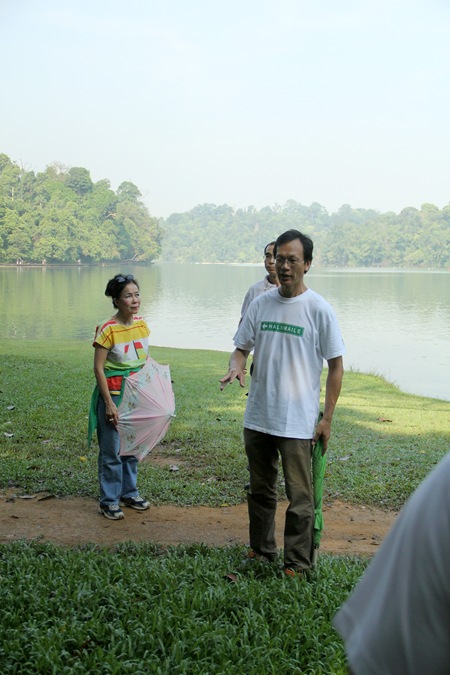
IMG_0733

And I guess it is also because of Dr Shawn Lum’s undeniable charm.

After a brief introduction about some of the dipterocarp genera that we can see today, we headed into Lornie Trail.

IMG_0743

The first species we saw was this Anisoptera megistocarpa. He mentioned that the secondary veins of this genus are looped at the margins, evident from the picture below.

IMG_0746

Just for interest, the common name of this species is Mersawa merah.
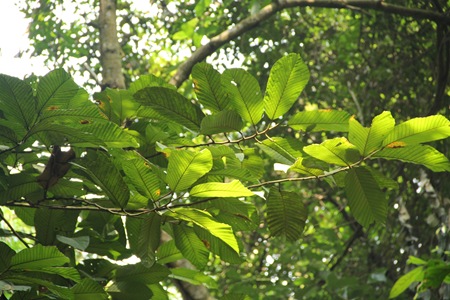
IMG_0770

The second dip we were introduced to was the Keruing gombang merah, or Dipterocarpus kunstleri. This genus have leaves that are wavy are the margins and bears some resemblance to a piece of corrugated cardboard.

IMG_0772

He told us the sad story of an adult Dipterocarpus kunstleri which died. However, its presence is still marked its many small baby trees like the two above.

IMG_0784

I had heard about the big stipules of Dips but I never knew they were this large! I believed that this one belonged to Dipterocarpus kunstleri. We can see them scattered throughout the forest floor around the tree.

IMG_0785

Shorea species have a twisted petiole compared to the other dips. The one above shows Shorea ovalis, a member of the Red Meranti group. It is rough on the underside.

IMG_0787

Managed to take a picture of the tree.

IMG_0790

And branches.

IMG_0805

This leaf belonged to Shorea macroptera, the underside of this is smooth and seems to have a distinct in-rolling along the margins.

IMG_0818

This is Shorea pauciflora. Note the twisted petiole in all the 3 Shorea species.
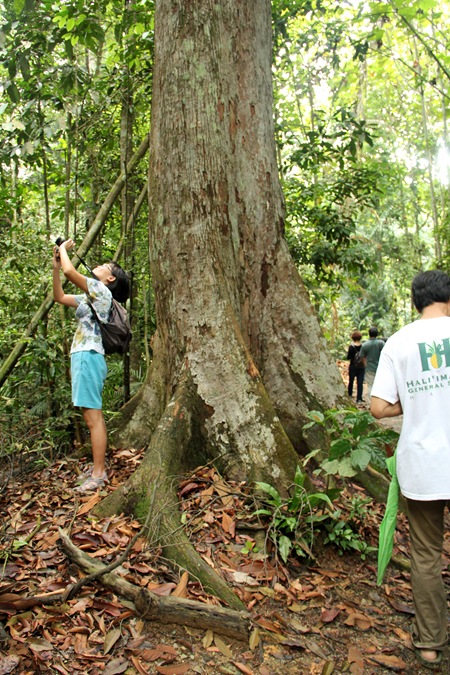
IMG_0846

The large trunk of Shorea pauciflora marks the end of our walk. I had missed out three species as I had no good photos of. Will do that another time when I come here another day.
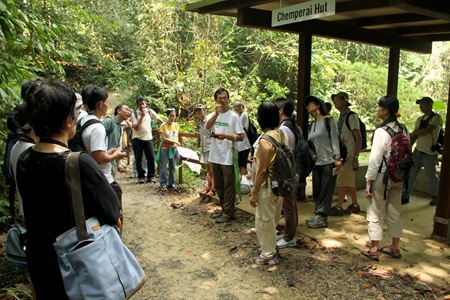
IMG_0822

It was really a nice morning walk with new knowledge gained. Luckily I was not that lazy that day to wake up early!

I have blogged about most of the species learnt during this walk in the total vascular of Singapore online, so that you may have a quick and easy search in case anyone need to refer. :)

Monday, November 22, 2010

Dipterocarp walk at MacRitchie Part 1

Guess I can’t help to quickly sort out my pictures and blog before sleeping. This post is the first of two parts of a walk which I attended with NSS, led by Dr Shawn Lum. This first post shows mainly some interesting but non-dipterocarp plants which we saw along the way.

IMG_0775

This climber is a fig, Ficus villosa. My first time seeing it out in the forest, but I guess its distinctive habit and shape gave it away.

IMG_0782

I found this interesting flower on the forest floor which Dr Shawn said belonged to the family Apocynaceae. Just did a search on my book on this family and its long, narrow calyx lobes helps to narrow it to the genus Strophanthus, probably  Strophanthus caudatus, a critically endangered climber.

IMG_0844

Isn’t this long spirally liana nice?

IMG_0840

Dr Shawn told us that this peculiar rattan with spines on the leaflets is a new record in Singapore, and a resident rattan expert, AL is currently writing on it. Update: Plectocomiopsis geminiflora, watch out for this upcoming Nature in Singapore article about this new record.

IMG_0829

This Rubiaceae is, as suggested by, Dr Shawn, a Hedyotis species. Will attempt to key this out another day. Please keep a lookout for updates here if you are interested. Update: Hedyotis congesta, now known as Oldenlandia cristata.

IMG_0819

The young reddish fronds of a centipede fern, Blechnum species.

IMG_0816

Somebody actually found the flowers of a native durian, Durio griffithii! The greyish back leaf also belongs to the durian.

IMG_0860

VB picked this out and guessed it as a Heritiera species. Indeed, Dr Shawn confirmed it as Heritiera simplicifolia. It is related to the Dungun, Heritiera littorali, a mangrove tree that has a dorsal ‘fin’ on their fruits. Hence, they are also fondly known as the ‘ultramen’ fruits. Not sure whether this plant above has this character too~

IMG_0851

During our walk back, VB and AN alerted us to the fruits of Garcinia griffithii. They are closely related to the mangosteen, Garcinia mangostana.

IMG_0852

The branching of Garcinia species are pretty characteristic, with angular straight branches extending out from the trunk.

Okay, totally shag out now. Will blog about the diperocarps on the next post!

Related Posts Plugin for WordPress, Blogger...