Showing posts with label Bidadari Cemetery. Show all posts

Sunday, December 30, 2012

A new Clover-leaf Desmodium in Singapore?

I’m back in Bidadari Cemetery to finish up taking photos of plants before the place is razed to become a HDB estate. Together with another enthusiastic lover of wildflowers, we went searching for macro subjects.

Untitled-5

One of the oddities I found was this little herb. The leaves are clearly Desmodium triflorum but the flowers are white instead of purple!

Untitled-6

The purple flower Desmodium triflorium grows just beside the white one on the same grass patch. I tried to see if they belong to the same individuals by tracing their creeping horizontal stems but they are apparently not.

Untitled-7

This is another similar species, Desmodium heterophyllum but it has larger leaves and the flowers are also starkly different close-up. The white flower Desmodium however is similar to D. triflorium in every aspect. I wonder if it is a variety or an entirely new species yet to be recorded in Singapore? :x

Update: Was just updated that this might indeed be just a variety of Desmodium triflorium. Oh well..

Sunday, December 16, 2012

Bidadari Trees

The now defunct Bidadari Cemetery consists of a big parcel of open space and a forested area. I love the former because the openness of the area with the carpet of greenery gives me an unspeakable sense of awe.

IMG_4618

Many of the trees which stand individually have the space to grow to their full size without restriction. It is just amazing to appreciate their size and form, not to mention that they serve as excellent models for me to collect nice photographic memories of them.


IMG_4598

An Acacia auriculiformis with a Ficus benjamina growing on it. The stray branch extending on the left reminded me of our iconic heritage tree (Fagraea fragrans) in the botanic gardens which had graced the back of our S$5 note.

IMG_4603

Pithecellobium dulce. I have been looking for a nice lone specimen for awhile, and this is probably the best place to take a shot of it. The straggly branches make it a very identifiable species from afar.

IMG_4591

The Indian Mango, Mangifera indica. This huge tree was fruiting profusely when I was there. The mangoes are rounded compared to the typical ovate ones. Probably one of the many cultivars of the species. The tree also hosts many species of epiphytes.

IMG_4631

Tembusu trees (Fagraea fragrans) typical form is an architecture wonder. Its primary branches will branch into many upright spokes.

IMG_4630

This Livistona rotundifolia palm (I think) is so tall that it is more than twice the height of the Angsana trees in the background! Beats me on why there is a need to grow so damn high, since there are zero competitors for sunlight in the surroundings.


IMG_4634

I have seen many larger Ficus benjamina trees but this particular one captured my attention more than anyone else, probably because of its extensive drooping leaves.

IMG_4621

Another of the same fig species (Ficus benjamina) but this time it comes in two. The two towering figs serves as a majestic gateway for the uncle with his two adorable dogs - Beacon and Dognut, as he lovingly told me earlier. The yellow leaves from the tree on the left is actually a mistletoe, Viscum ovalifolium.

And so, a tribute to the “heritage” trees of Bidadari, before they will be fell for residential development next year. I hope at least some will be conserved!

Tuesday, June 26, 2012

The Bidadari Squirrel

IMG_9714

The variable squirrel, Callosciurus finlaysonii, has long established itself in the Aljunied areas since early 1990; according to the book “Wild Animals of Singapore”.

Native to Thailand and its surrounding countries, this beautiful squirrel is unfortunately not native to Singapore. To me and my friends, it doesn’t really matter since one is almost certainly to squeal in delight exclaiming “so cute!” seeing the squirrel and its acrobatic antics.

It is almost a guarantee that you can find the squirrel in Bidadari Cemetery in the mornings. We were particularly lucky as quite a number of large figs in the place were figging, and we get to see one of them foraging about a Ficus microcarpa.

A side effect of squirrel-watching is the same as birding though. Intense neck craning from looking up the tree for too long.


Untitled-3

A religious one also went about its prayers before commencing with its breakfast at another fig tree.

IMG_9798

It must really suck to have Acrophobia, or a fear heights for a squirrel. Look at how intensely it grabbed the tree branch below. It was almost as if it was scared to fall down. Haha~

IMG_9802

No problems hopping on the ground though, as this one below escaped from our overwhelming curiosity and enthusiasm.

IMG_9741

For those who are unaware, Bidadari Cemetery, just like the Bukit Brown Cemetery, will be eventually cleared for residential use. While a large portion of the area are open spaces (most graves are exhumed), it still host a number of big mature trees like the Tembusu (Fagraea fragrans), Bodhi Tree (Ficus religiosia), Malayan Banyan (Ficus microcarpa), Benjamin Fig (Ficus Benjamina). All these fruit/fig bearing trees provide plenty of resources for birds and this charismatic squirrel. The open spaces and good shade from the trees also make a nice spot for a picnic or kite-flying.

Therefore, take a look before it is gone!

Saturday, July 31, 2010

Bidadari Cemetery

My weekend trip today was to Bidadari Cemetery, recommended by L, who accompanied me this morning.

The aim was actually to bird-watch, but we did not see any interesting ones besides some orioles, bulbuls, koels, etc.

P1000124
To say that it is a cemetery is actually incorrect, since most, if not all of the graves were already exhumed. It is now a place as we observed, for people to jog and walk their dogs.
P1000130
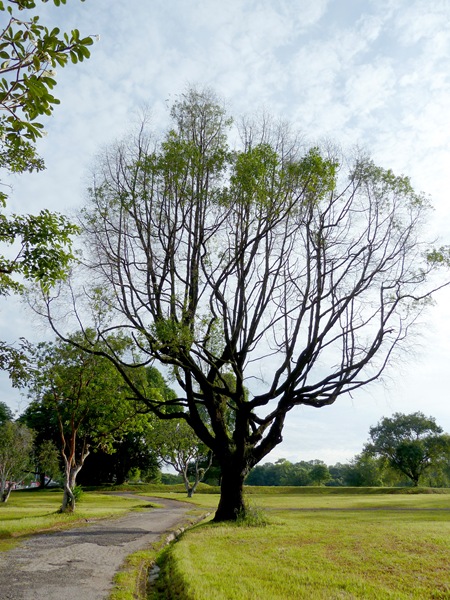
However, quite a lot of nice trees like this Tembusu, Fagraea fragrans still stands. Its branching seems like upward point fingers, rather appropriate for a cemetery tree I suppose?

P1000202
There were many other common trees along the area which I won’t blog about. One plant which I was particularly curious about is this tree.

P1000134

The fruits resembles the Noni, Morinda citrifolia, but all of these leaves look much lighter green in colour. Could this be a different Morinda? A check in Kwek’s vascular flora list however shows that M. citrifolia is the only tree, while the rest are climbers… Update: Morinda elliptica. Thanks VB for the ID. Update: Seems like this plant is STILL Morinda citrifolia, according to Kew, even though it looks very different from the the Morinda citrifolia. Update: Apparently, M. elliptica is still valid, according to Razafimandimbison (2009). Thanks Kwek for the research.

P1000139
It took me a moment to recall this rather common wayside tree, Gliricidia sepium. This was my first time seeing its flower.

P1000159 copy
This cemetery is one of the few places to see this variable squirrel. Though exotic, we can’t help exclaiming about its cuteness!

P1000178
I managed to take two close ups of the squirrel. This one above crossing its arms while hanging outside down…

P1000179
And another picture of it biting a branch. I also saw it nibbling on the leaves of this Gliricidia. Part of its diet?

P1000201

A Clerodendrum sp. It looks like the hydrid C. x speciosum.

P1000249
After finishing our walk, we realised that we were very close to SPCA, so we went in to have a look. This cat with beautiful blue eyes was my favourite!

P1000245

Two adorable kittens here…

P1000253
Another kitten which L was particularly attached to.

P1000268
Our next point is to investigate a forest fragment near Hougang Ave 3. Just at the forest edge, we were rudely interrupted by these four dogs.

P1000270
It was always nice to see streams in the forest. Gives me the delusion that it is a freshwater swamp forest.

P1000276

However, I was rather disappointed that the vegetation in the forest were all common plants. Sea almond, fish-tail palm, Banyan and starfruits trees; money plant climbers; Pandan and Alocasia near the stream, and the ground sprawling with Piper sarmentosum.

P1000279

Remains of a village? Or is this some valuable antique?

I decided to leave soon after staying no more than 20 minutes since there was nothing new to discover and the undergrowth was very also thick (scared of snakes).

P1000282
I was pretty upset that my Anta track pants which has served me well was torn. What’s worse was that that the attached compass and rubber tip of my two weeks old hiking stick came out and was no where to be found. Damn… =.=”

Not sure whether I will keep up my weekly fieldtrips since my goody field trip kaki L will be going on SEP for a year soon. All the best!

Related Posts Plugin for WordPress, Blogger...