Sunday, September 27, 2009

Mangroves from Punggol to Serangoon

After work yesterday, I decided to head down to ground truth some mangroves around my area for my friend. I engaged my dad’s help to drive me straight down to Punggol Beach before heading back using my bicycle.

IMGP2807

Large patches of the wasteland here are being cleared in the vicinity.

IMGP2811

There is a really super tiny mangrove near the beach. Unfortunately, I did not check the tide and it was rather high then.

IMGP2814

There were lots of mudskippers at the drain linking to the mangrove. I am not particularly good at identifying these fishes, but they look a little like the dusty-gilled mudskippers (Periophthalmus novemradiatus). Please correct me if I am wrong.

IMGP2821 
Lots of Ellobium snails (Cassidula sp.) on a low stem of sea hibiscus.

IMGP2829 
A tree climbing crab retreating into a hole. However, this is not the tunnel of a mud lobster mound but rather, one from the concrete drains!
IMGP2834

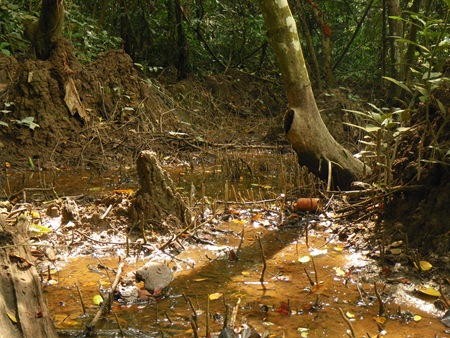
At the opposite side of the road, there were also some remnant of a mangrove. Api-Api (Avicennia sp.) needle roots poked out of the stagnant water-logged mud.

IMGP2832 
A huge clump of mud lobster mound stood at the centre with sea hollies (Acanthus sp.) over growing it.

IMGP2835  
I also caught sight of some beautiful orange fungus.

IMGP2868

Next, I cycled over to Sungei Serangoon. The dam is already being constructed and this, together with Sungei Punggol will be our next two up-coming reservoirs.

IMGP2872

I spotted a small water body leading into this Acacia auriculiformis dominated forest filled with Asystasia gangetica undergrowth and thought some mangroves might be hiding inside. Hence I made a decision to bash in.

IMGP2876
 
Here is the reddish stream that is probably covered with tannin from the fallen leaves; but no mangroves. I wonder what life is present inside.

IMGP2878
 
A Lampin budak (Claoxylon indicum) plant. The leaves of this native plant is used by the Malays previously as diapers for their babies.

IMGP2881

And lastly, a view from Buankok Bridge of the mangroves with Sengkang estate at the background. Though it looks pretty lush, but it is just a thin strip along the embankment. With the dam being completed soon, this entire river will be dammed up and will convert into a freshwater body eventually. What will happen to the mangroves?

Monday, September 21, 2009

Another encounter with Banded Leaf Monkeys

A tiring day after a guiding session at Semakau yesterday, I still decide to head down to CCNR to get some pictures that I need for a publication. Luckily I managed to get HF, who was also looking for company to survey the banded leaf monkeys.

wzz

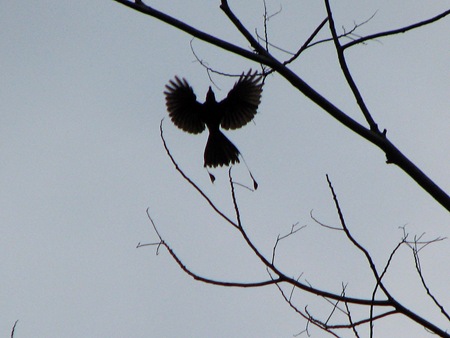
I arrived earlier than I wanted to (wasted half hour of sleep) and as I walked slowly to our meeting point, I caught sight of this bare Albizia (Albizia falcataria) tree. There were a few birds perching on it, including the common flameback woodpecker, some doves and a few Greater Racket-Tailed Drongo (Dicrurus paradiseus) shown above.

kjk

HF soon came after and after trekking for awhile, she pointed out some hanging ‘fruits’. It was only later when I realised that they are the flowers of Petai (Parkia speciosa), where the seed pods were eaten and popularly known as smelly beans.

zzz
After taking the pictures that I wanted, we were rewarded with another glimpse of the Banded Leaf Monkeys (Presbytis femoralis). This is a critically endangered primate in Singapore and recent surveys by Nparks (in the news) indicated that there are about 30 or so individuals left in the wild. This particular monkey was picking on a leaf, probably to eat before leaping deeper into the forest.

zzzz

I did not managed to get any nice shots since they were under the canopy and mostly out of sight. I did get a fleeing shot of the back of this adorable monkey though.

IMGP2753 
Lastly, I caught sight of this Giant African Snail (Achatina fulica) eating on what looks like a Malayan Brighteye (Torenia polygonoides), a common turf weed. This exotic snail is known to have a voracious diet (practically on anything!) that explains its extremely invasive nature.

Semakau Intertidal Walk 19 Sep

Rushing down from work wearing pants, shirt and leather shoes, I reached Marina South Pier for a guiding session at Pulau Semakau with the Raffles Museum. It had been almost 3 months since I last guided and it is about time to wipe off my rustiness.

IMGP2706 
Me and Robert were guiding another volunteer group, the Singapore Zoo Docents.

IMGP2703

First up was the Swimming Anemone (Boloceroides mcmurrichi). True to its name, it can swim like a jellyfish by pulsating. Check out this link.

IMGP2711 
RY found this Spider Conch (Lambis lambis) among the seagrass meadow. Conches are fascinating molluscs in that they have two alien like eye stalks that peep out of their snail to scan the surroundings for safety.

IMGP2708

The Sandfish Cucumber (Holothuria scabra) is an edible species of cucumber that is a delicacy for Chinese especially during the New Year period. They feed on detritus and has the habitat of burrowing in the sand, perhaps to escape from predators and also the sun.

IMGP2720

Love was in the air and this was reflected from the tremendous number of pairing Common Seastars (Archaster typicus). However, it is said that the lustful males has such an urge to mate that sometimes they will mount on another male!
 IMGP2715 
We also found other stars like the Knobbly Seastar (Protoreaster nodosus) on top and a seastar yet to be identified.

IMGP2718
 
The Long Spined Sea Urchin (Diadema setosum) has very long spines that are slightly venomous. However, the spines are very brittle and thin, thus will easily penetrate through the skin of the unknowing.

IMGP2719

Lastly, the Onch Slug (Onchidiidae) is an extremely well-disguised air breather that has a tough outer skin for protection.

In sum, a nice day out with nice finds and company. Thanks for coming guys!

Related Posts Plugin for WordPress, Blogger...