Yesterday, the Semakau guides had an opportunity to go on an exploratory trip to Big Sisters island.
Trying to ID the two species of turban shells that we have locally, I spotted one, probably Turbo burneus (from its rougher operculum) that has white stuff stuck onto its shell. That is probably the eggs of the nerites (Nerita sp.) that were found all over the sea wall. Weird that they will lay them on another live animal though~
This should be the other turban shell, Turbo intercoastalis with its smooth operculum or "cat's eye". These marble like covering was used as buttons in the past.
While we were looking all over the exposed lagoon, July went to search for the endearing land hermit crabs (Coenobita sp.). He found many under a tree and there was one that was too big to hide into its spiral melongena shell (Pugilina cochlidium) so we were able to get a good picture of it.
Octopi are very common in our shores and Robert managed to find one stationary on a rock.
Squids can be normally identifiable by its pair of arrow shaped fins at the end of its body. They also have a thin, transparent quill shaped bone in their body.
There were several genera of hard corals in this lagoon. This is a lettuce coral, Pectinia sp. It can produce lots of muscus when disturbed and it is thought to be one way that can help to remove sediments from itself.
Robert saw this beautiful florescence green Euphyllia sp. Also known as the anchor corals, their tentacles normally end in the shape of an anchor.
This is a turban coral, probably Turbinaria mesenterina. They were so named as some of them can become highly convulated, especially under shallower waters, which is likely to be an adaptative to screen off excess light.
This mat of stuff are zoanthids (Palythoa tuberculosa). Many zoanthids, including this species, incorporate sand to strengthen their tissues as I learnt from Ria's posting when Dr James Reimer came to Singapore.
There were lots of red swimming crabs (Thalamita spinimana) at night. This one was grazing on algae. Swimming crabs belong to the family of crabs called Portunidae and they are characterised by their last pair of paddle-shaped legs.
July and the girls found this reef hermit crab (Dardanus lagopodes) inside a spider conch. This was only my second time seeing this, the first from Raffles Lighthouse.
To me, the most interesting find is this orange moon snail with a pretty translucent mantle. I will try to check out the ID later. Update >>> One of our local molluscs expert, Siong Kiat helped to place an ID on this moon snail. It is Natica zonalis.
There was another moon snail beside it. This pearly white moon snail (Polinices mammatus) is probably the most common species in our shores.
Towards the end of the trip, RY found a school of striped eeltail catfish (Plotosus lineatus), seeking safety in numbers.

Showing posts with label Big Sisters. Show all posts
Showing posts with label Big Sisters. Show all posts
Monday, October 20, 2008
Exploring Big Sisters

Wednesday, February 21, 2007
Video of eel eating 8-legs
Very blur, badly taken videos of the eel swallowing the poor octopus at sisters island. But at least you can hear from the background the excitement from Dr Dan and Ria. :D Enjoy.
Swallowing 8-legs
Done with eating
Tuesday, February 20, 2007
Trip to Big Sisters
Happy new year! What way to celebrate CNY then to go for another intertidal trip? Personally I hate visiting relatives, luckily got over the agony in the first day ;p
Me and Kok Sheng the amateurs are eager for this trip so we signed up together. First time to Sister's too! Rain was pouring badly; luckily Kok Sheng had a spare poncho with him. I going to buy one before the next trip lao. Now I realized its importance.
At sister’s Dr Dan brought his students to the exposed lagoon and began teaching his students about the intertidal life together with Ron.


(Left) A hole made by some fish, which Dr Dan said that it decorate its with pebbles. (Right) An uphole and downhole which is actually U shaped tunnel by a 1m long worm. Gosh, can anyone recall their ID?


Dr Dan spotted a trail which he said was a moon snail trail and Ron scope up the sand with snail inside. I was totally flabbergasted with this 2 =S. And to the right is a sand collar containing the moon snail's egg (hope I din remember wrongly).
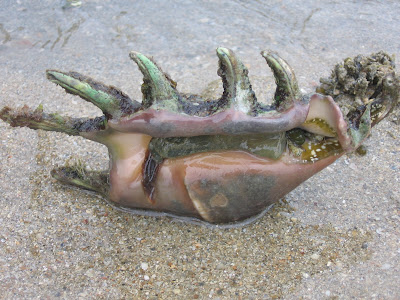

This is one of the more amazing finds for me. Finally I saw the spider couch! It has two pretty little eyes, barely visible in this photo. Ron was telling the students how the muscular tail or operculum is used for hopping. But alas it didn’t performed for Dr Dan they all. But just as they left, it started flipping itself over. Haha, its really very adorable.
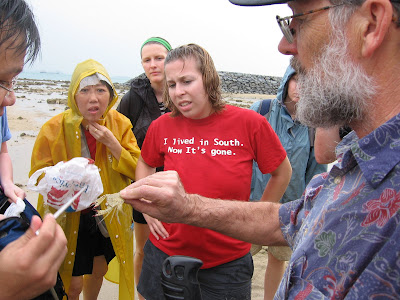
Dr Dan showing his class the flower crab. This guy really knows how to catch crabs! The swimming crabs always look ready to pinch me everytime I approach them. Here Dr Dan was pointing out to the two different set of claws used for.... eh shit, anyone can refresh me again?

A Diadema sp. sea urchin. omg I din know we can find them here! They are algae gazers and scavengers.

A damn long worm! At first I thought that Eunice was just a name which they affectionately named it after but it was in fact its genus!

And here, Dr Dan with his green bowl looking for more animals.
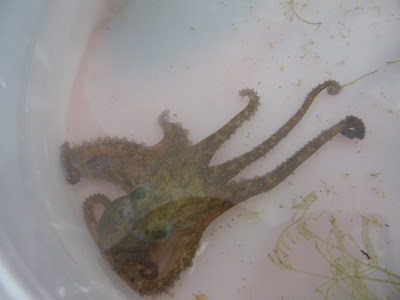
A small octopus found by Kok Sheng.

As the nightfalls, we heard that wildfilms had found a blue spotted fan-tailed ray (Taeniura lymma).
Round 7pm, we headed back to the shore for a break and dinner. Delicious curry puffs with some 100 Plus! Can't ask for anything more refreshing. heh

The first sight at the night walk. A huge octopus! Wa, this has to be the biggest I have seen so far.

A beautifully pattern brittle star. One could easily mistaken its arms for a worm. If you look closely, one of its arms is broken and another one is slowly regenerating out of it.

Here Dr Dan subdued another crab. A mosiac crab. It is said to be more posionous than the egg crabs.
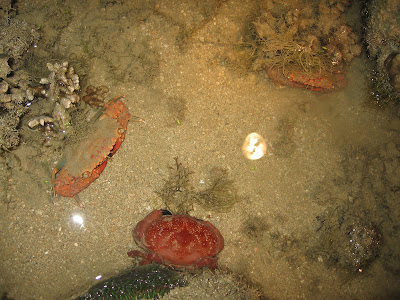
Look what we found. 3 crabs having a meeting?!! Two swimming crabs and a red egg crab.
Fishes fishes and more fishes! Everyone seems to be coming out at night!
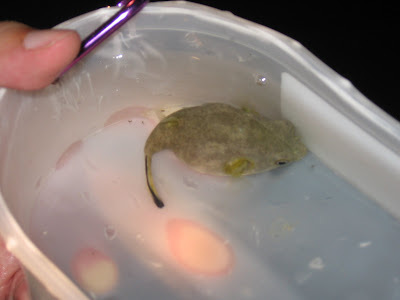
A cute little puffer fish all blown up. I still dun understand why its yellow black tail fin is rendered useless and fixed at a curved angle. Or is it just having a spasm?

The master of camouflage; the toadfish...

and a flathead

Now this is one interesting guy. Unlike other fishes which rely on camouflage and speed, it will rather just flip on its side and play dead! Can anyone ID?
Other fishes like butterfly fish, large halfbeaks, cardinal fish and other big fishes bumping at my booties :D and fishes that jump in the air when we shine our torch over it! What fishes are those!

Spotted by Dr Dan. A beautiful sea anemone.
Spotted by Dr Dan. A beautiful sea anemone.

A nice sponge with a big osculum.

This had to be the sight of the day. An eel eating an octopus!

A new sea cucumber for me. Pink with red strips.

Sitting in a coconut husk, a land hermit crab.
Woa, what an amazing day. Totally blown over by what I saw. I also have to get some new equipment for future trips, a bigger container and metal chopsticks. Almost broke kok sheng's wooden one when trying to pry the mosaic crab.
Subscribe to:
Posts (Atom)
