Showing posts with label Bukit Timah. Show all posts

Saturday, January 30, 2010

Tigers from the Past

NeI find the Newspaper SG which Ria used to dig out some past of Pulau Semakau and Pulau Sakeng very interesting. I decided to try to see if I can get some articles from our natural history and wala! Managed to find some articles on tigers in the past. Click on the picture to enlarge.

I used the keywords ‘Tiger’ and ‘Bukit Timah’ to search since searching ‘Tiger’ came out many entries from Malaysia rather than Singapore and searching ‘Tiger’ and ‘Singapore’ came out more soccer stuff and tiger beer than the animal itself. Bukit Timah is known to be a ‘Tiger Resort’ last time so this is the best bet for a successful search.

The last suspected tiger killed was in 1930 near Chao Chu Kang Village. But I found one dated 1935 whereby someone seemed to heard a tiger roar at Bukit Timah Hill. I guess that was never verified. Have a fun read!

Thursday, August 13, 2009

Three Moths

Running out of creative juices now so pardon me for the title. Anyway, during a recent frogging trip with D at BTNR, we found a few beautiful moths as shown below.

IMGP2440

A commonly sighted species of Owl Moth, Erebus ephesperis
Family: Noctuidae
Subfamily: Catocalinae

IMGP2426

A beautiful moth with a army-camouflage wing, Eudocima smaragdipicta
Family: Noctuidae
Subfamily: Catocalinae

DSC_0873

Lastly, an unknown Hawk Moth suspected to be Cechenena sp.
Family: Sphingidae

Thanks to Roger for the latter two IDs and D for the taking the last pict.

Wednesday, July 29, 2009

Fruits of Bukit Timah

A backlog only posted now as I needed help in ID-ing these forest fruits. I was helping MS again at BTNR again for his surveys two weeks ago.
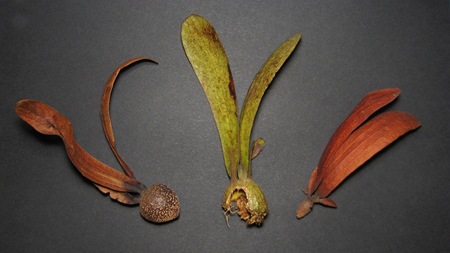
IMG_4696

It was really a good time to see lots of interestingly shaped fruits, especially the shuttlecock shaped ones. The above shows the Keruing, Dipterocarpus caudatus ssp. penangianus. Left: matured, centre: immature and seed eaten up, right: a mutated form of the fruit.

IMG_4693

Some others, from the left, Ptericymbium tubulatum (Malvaceae), Shorea curtisii (Dipterocapaceae), Shorea leprosula, Vatica odorata (Dipterocapaceae).

IMG_4699

And also other intricately shaped fruits dispersed by the wind. Top & left: Pentace triptera (Malvaceae), while the other two belong to some unknown climbers.

IMGP2242

At a particular location in the forest, it was covered with many Kokoona reflexa (Celastraceae) fruits. Some were already germinating and I found this pair looking like rabbit ears.

IMGP2238

It was also the season for our native jackfruit (Artocarpus lanceifolius) and the long-tailed macaques were greedily gorging them high up the tree and throwing the leftovers on the forest floor. We had to duck carefully to avoid being bombed.

IMGP2239
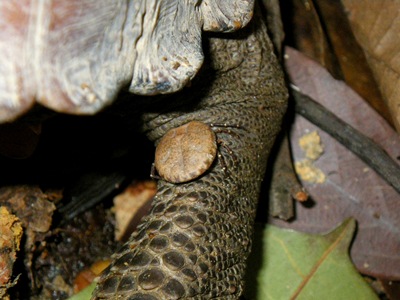
MS found this Spiny Terrapin (Heosemys spinosa) crawling slowly on the forest floor.
IMGP2240
He mentioned that most of the time, big ticks were stuck on them and sure enough, there was one at the hind leg. Luckily none of those were on me during my previous horrifying tick encounter.

IMGP2234

As John had helpfully pointed out, "these are the common Asian honeybee Apis cerana, which can indeed sting, although they are generally not aggressive if not provoked."

IMGP2247

Of course, the star of the trip was when we were back at the counter. Apparently, someone had rescued a juvenile Colugo, Galeopterus variegatus and passed it to Nparks for safekeeping. Isn’t it super adorable? However, the sad news when I went back again last week was that it had refused to be fed and had died… Alas…

Wednesday, July 22, 2009

Cheng T’ng

I am back at Bukit Timah Hill again. Was actually here with MS to help him with his CTFS surveys last week but I have not blogged about that yet, since needed his help for some IDs.

It is really a good time to visit BTNR now as it is the masting season, where lots of big trees will flower and fruit. One of these trees is Scaphium macropodum.

IMG_4704
Here is the tree that can be seen just along the main trail at the start of Keruing Path.

IMG_4711

Here is a close up of the fruit cluster.

IMG_4706

The fruit is made up of a papery wing that aids in seed dispersal and at one end, a hard pericarp that encapsulates a seed. The wing structure causes it to spin, slowing it’s movement to the ground thus allowing it to move further away from the parent tree by the wind.

IMGP2268

The seed when placed in hot water produces an edible jelly that is used in our local dessert, Cheng T’ng. I tried it, but unfortunately only managed to get a little jelly popping out here and there as shown in the picture.

IMGP2263
Nparks happen to have a meeting here too and I met Adelle with her civet cat that was rescued at Ubin. Man, it was really damn adorable!

Monday, June 15, 2009

Cost but no effect, the Bat Lily

The Bat Lily (Tacca integrifolia) is a rather inconspicuous understorey herb common along the trails of Bukit Timah Hill. However, the same cannot be said for its inflorescence. Bat-wings like bracts are erected above the flowers and showy bracteoles hang down resembling the whiskers of a cat.

IMG_3886

Since seeing this pretty flower in Feb this year, I have wondered what kind of animal pollinates for this plant. A random search in the net revealed a rather surprising discovery.

IMG_3885

A study conducted on a similar species, Tacca chantrieri is actually a highly selfing plant. It was previously thought that Tacca species were cross pollinated by flies, due to its dull colours and musky odur; a phenomenon known as sapromyiophily.

However, several attributes including the low pollen to ovule ratio and the close proximity of anther and stigma gave evidence that they are predominantly self pollinated. Experimental removal of their extravagant displays also have no distinct effect on fruiting, indicating that such structures might be a result of a relict syndrome; meaning something that is of use in the past but with no functional significance now.

Tuesday, June 9, 2009

You Tick me off!

KB invited me to help out HS in his survey at Bukit Timah Hill today. It was a pretty challenging field trip, carrying ladders, climbing slopes etc. I was breathless by the end of the journey. Phew, what a nice workout though.

However, the more shocking discovery was when we were packing up to leave. That was when I sneaked a peep at my socks where I felt this persistent prickling throughout the trip. I noticed many tiny little dots on my socks and a closer inspection revealed that they were moving. That was when I shouted ticks!

IMG_4541

The three of us immediately started to pull out our socks. Apparently I was the one who had the most ticks on me. If you looked closely and count, just this side of one feet already have 24 ticks! Luckily I had a pair of tweezers with me and plucked these blood suckers off one by one. Some were anchored so firmly on me that it drew blood when I forcefully removed them. But it was just a tiny bit of red.

Evidently, socks do not provide much protection since so many managed to crawl under it to my flesh... Think there must be about a hundred on my legs at that moment. Probably another hundred on my socks. Shivers...

IMG_4555

Ticks belonged to the class of Arachnida, the eight-legged group of arthropods, same as the spiders. It is said that they attach themselves to a host using their mandibles and a feeding tube known as a hypostome, which happen to have backward pointing spikes like a rattan. No wonder it was hard to remove them.

I threw my bug covered socks into a ziplock and tried to take some photos using my raynox macro lens at home. Unfortunately, these pesky little buggers were already dead by then. But at least you can have a view of these nasty parasites. Still, I felt that it was an interesting experience, though I don't endeavour to have another encounter!

Anyway, don't worry. I probably picked up those ticks (or rather, they hunt me down) off trail. Another reason why you should stick to the route at Bukit Timah Hill.

Wednesday, October 22, 2008

Bukit Timah Hill with Clementi Town Sec

Today me and RY had the opportunity to guide a class from Clementi Town Secondary School after several postponing due to weather conditions.

IMG_2566
Going through South View Path, we saw many Gutta Percha (Palaquium gutta) with their characteristic golden underside leaves. These plants have a sticky white sap that is being used as a material in dental fillings due to its inert nature. In the 1900s, many flora were destroyed in the attempt to harvest this plant in order to make insulation cables for submarine lines.

IMG_2567
A huge woody climber hanged just across the pathway. Also known as lianas, these plants serve as connectors for many animals like squirrels to move between the trees. However, the unfortunate thing is that if one fell, it will drag down all the other trees that are entwined with it.

Unknown caterpillar

The best find of the day: One of the students spotted a huge caterpillar just under a St. Andrew's cross spider! It is a caterpillar of the butterfly, Yellow Archduke (Lexias canescens).

IMG_2571
This tall Red Dhoop (Parishia insignis), is named as a heritage tree. This is a program started by Nparks to conserve our mature trees. They are given regular inspection and pruning. Even lightning conductors are installed to protect them against lightning strikes.

IMG_2573
The presence of Terentang (Campnosperma auriculata) gave an indication that we are within a disturbed forest as this a tree that is found in a mature secondary forest. The leaves are very distinctive, having a folded pair of "ear-lobes" near the leaf stalk.

IMG_2578
This is a very common tree in Bukit Timah and it is also the name of one of our housing estate. The wood of the Tampines tree (Streblus elongatus) is very hard and tough, thus they are used to make tool handles.

IMG_2593

The leaf litter plant (Agrostistachys longifolia) has an interest way of getting additional nutrients. Its rosette arrangement of leaves (monopodial branching) helps to trap dead litter between the leaves and they will eventually decompose and obtain the necessary nourishment since the forest floor is very nutrient poor.

IMG_2580
The Singapore fern (Tectaria singaporeana) like all ferns, produce tiny spores that allow effective wind dispersal. However, not all the leaves have spores. Only the mature ones will have them on their undersides. Its Malay name is called Paku Biawak, or the Monitor Lizard Fern.

IMG_2581

The nutmeg (Myristica sp.) is easily identifiable by the leaf branches which spread out like the spokes of a wheel. Nutmegs are dispersed by birds like pigeons and hornbills, which are becoming rare in the forest. Without these agents, they risked overcrowding and competiton for resources if they all grow in the same vicinity.

IMG_2594
This is another species of fern, known commonly as the centipede fern (Blechum orientale). Why? Because the young fronds of these plants actually look just like centipedes!

Turning up to Kruing path, we saw the huge Seraya tree which indicates the presence of a primary rainforest. These huge dipterocarps are an important source of quality timber, also known as meranti in the timber trade.

IMG_2588
Anyway, flipping over a dead log found there, I showed the students a termite nest. Termites are actually not very closely related to ants. They do not undergo complete metamorphosis like ants but just having a nymph stage, skipping the larvae and pupae stage all together. They also do not have a distinct separation of their thorax and abdomen like ants, which have a clear "pinched waist".

Giant Forest Ant nest
One of my sharp-eyed students spotted another great find for us. A giant forest ant (Camponotus gigas) nest! These ants usually hunt in small groups or individually so this is indeed a rare sight for me.

IMG_2707
This is not the common black house crow that we see in our urban estates. Instead, the Greater racket-tailed drongo (Dicrurus paradiseus) is a forest dwelling bird that have two long feathers extending from the tail. They are also a great mimic of other bird calls.

IMG_2590
And of course, the trip will not be complete without the ant plant (Macaranga bancaca). The heart gaster ants (Crematogaster sp.) lives in the hollow stem and feed on the fat-rich globules found within the dark red stipules. In return, they fend off herbivores or other smothering climbers.

IMG_2889
Finishing the walk, we had some time to head towards Hindhede Quarry where granite used to be mined. A troop of long-tailed macaques (Macaca fascicularis) were basking at the railings and many juveniles were hanging on to their mum or playing about.

We also managed to see other animals like a stick insect, a jumping spider eating a fly and two clouded monitor lizards (Varanus bengalensis). In fact, one jumped out from the shrubs in front of a student, scaring the life out of her ;p. Unfortunately, I was always engrossed when guiding and usually forget to take photos to blog. A good and eventful day nevertheless I must say, with a bunch of enthusiastic and attentive students who managed to bear with their hunger pangs and spotted lots of animals for me along the way.

Monday, September 8, 2008

Crabbing at BT

Sorry for the lag of post recently. Have been preoccupied recently by several issues and plus also my laziness...

Last friday, I accompanied daniel to hunt for crabs at Bukit Timah hill. Several Nparks staff are there to guide us the way to the freshwater stream where he began his sampling. It was quite a fruitful night and we saw many nocturnal animals, the only regretful thing is that I failed to get a picture of a moth, Erebus ephesperis, which was frightened by the flash from a camera. Thanks to Daniel too for letting me try out his new Nikon D60, its really awesome to take pictures using DSLR for a change! Enjoy the pictures!

Flatworm

A slimy land planarian worm with a distinct hammerhead

DSC_0165
The streams are dominated with this big freshwater crab, Parathelpusa maculata.

DSC_0203
A shiny white pearl on the leaf. I wonder what animal makes this. Is this an egg?

Scorpion
My first time seeing a scorpion in Singapore! I wonder what species is this...

Whip Snake

The star of the night is probably this beautiful Malayan Whipsnake, Ahaetulla mycterizans, which we found slithering at the small bamboo forest. This is a less common relative of the Oriental Whip Snake, Ahaetulla prasina, which is found throughout Singapore while the former is reported only in the CNR.

Saturday, January 5, 2008

Aquatic life at BT

Went with Daniel in his honours project for his Johora singaporeansis project again, this time at BTNR. It was really filled with life! But had limited shots due to low batt and my failing old camera condition.


Pink-headed Reed Snake, Calamaria schlegel. It is non-venomous and said to be a mimic of the venomous Blue Malayan Coral Snake.


A fallen log in our way. The heartwood is blood red in color, looks just like blood... ID anyone?

Lots of forest fishing spider standing on the stream surface waiting for small preys to ambush on.

Cryptocoryne timahensis, a hydrid species aquatic plant found in Singapore. Surprisinginly, it is said to be sterile and found only here so its extremely rare. More on this website.


No Johora singaporeansis found again in this area. Instead, only saw one of the three endemic freshwater crabs in Singapore, a male Johnson's Freshwater Crab (Irmengardia johnsoni) above.

Friday, June 22, 2007

A Guide to Bukit Timah Nature Reserve

Kicking start our Tioman field studies module, we were told that part of our grading assessment will be based on guiding 2 field trips in singapore to our foreign friends who were taking this module too. The first trip is on Bukit Timah nature reserve. Being true blue kiasu Singaporeans, Kaiqin, Denise and me decided to make a recee there first. Shun de, Pei xin, Daniel also came except for Diana as she was not feeling well. We invited our guide for the day Dingli to show us around this place where he often bird frequently. He is an excellent guide! Thanx dingz for taking the time off for us.

Dark green color showing our remaining primary forest

Bukit Timah is the highest point in Singapore but it just reaches up to 164m above sea level. It contains a dense area of primary forest but other parts of the Central Catchment Nature Reserve also contain isolated fragments of it surrounded by secondary forests. We can see how disturbed our forest are from its primary state. It takes a long time for secondary forest to regenerate to its initial primary state, which can take up to a thousand years or more as mentioned by our guide.


Dingz emphasizing the importance of dipterocarps

One of the defining vegetation in a primary forests of this region is the presence of dipterocarp trees. Dipterocarps are also an important source in providing high quality wood and is commonly known by meranti in the timber trade. The largest genera in this family is Shorea with their characteristic 'shuttlecock' fruits.


Shorea curtisii

Shorea curtisii, or more commonly known by their malaya name Seraya is the most dominant dipterocarp species here. They are grow well over 30metres, often defining the topmost canopy, which is why it often succumb to lightning strikes. The tree is very easy to spot by their thick tall trunks and fissured bark.


Their leaves grow in little clusters like a cauliflower. Another interesting feature about this tree is their fruits, which are shaped like shuttlecocks with 3 fully defined wing like sepals and 2 underdeveloped ones. The tree fruit rather rarely, about once every 5-10 years so its a rare sight to see them! Well, but we werent so lucky this time...


Terantang (Campnosperma auriculata) is also a very common tree here (common in secondary forests), with many saplings too. The defining features is their leaves, which is notched at the top middle end and a characteristic "ear lopes" at the auricle, which is also the basis of their species name. Some of its economical uses includes making of match boxes using their soft wood.


Rattan

Palms are a definite score if we know how to ID, as many were growing just at the sides of the trail. Rattan is an example of such and it consists of abt 600 species of taking forms from climbers to shrubs. Many have sharp spines to aid in climbing or protection. The stem of the rattan is an impt source for weaving furnitures and baskets.

The Burmese fishtail palm is another common palm of the secondary forest, so common that I din bother to take a picture of it. As the name says, the leaves looks like the tail of a fish.

The Tampines tree

One tree that Singaporeans should know about is this tree, Streblus elongatus or Tempinis. Our housing estate Tampines is named after this tree. The wood of Tampinis is very hard and tough, thus they are used to make tool handles.

Another tree, Keranji (Dialium indicum), as you guessed it, is used to named the estate Kranji. Due to its attractive sheen of dark red or brown, the timber is often used for decorative paneling and flooring.

A large pandan sp. plant with pleated leaves for additional support. Pandan, P. amaryllifolius in particular, is commonly used in SEA cooking, to add flavor on nasi lemak, pandan cake etc.


Mosses are found commonly at moist areas due to a lack of cuticle to prevent water loss and the need of water to complete fertilization. They are non-vascular plants aka bryophytes hence the small size.


These mini rambutan like things are actually galls. It can be said to be something similar to a tumour, with proliferations of cells causing the bumps. Galls are form due to chemical excretions by various factors, like fungi, bacteria, insects, mites and even other plants like the mistletoe for example. The shape of the gall is very characteristic of the agent causing it, thus they can be identified directly by the type of galls form. Generally, they are not fatal to the plant itself, its just unsightly and gross... Definitely not a plus for gardeners...


It is easy to spot different kinds of fungi on logs laid as steps along the trail. Fungi are not plants and they do not photosynthesize. Instead they digest dead organic matter for their nutrition and plays an important part in decomposition and nutrient recycling.

Lichens can be found everywhere on trees barks and they consist of a symbiotic relationship of a fungus and algae. The fungus is obligatory towards its algae inhabitant, needing it that it photosynethsize for carbon sugars for food. But theres this ho ah over whether its algae parthner is strictly dependent of the fungi. Since the scientists cant make any sense of it too, I wun go any further on this ;p


Since Im already on the topic on symbiosis, I will continue with it here. Sure tested (as this plant is found everywhere near the trail) is the relationship of this plant, the common Mahang (Macaranga bancana / Macaranga triboba) with the heart-gaster ants. The ants live in the hollow stems of this plant, and obtain food from the protein rich red-brown stipules (see picture). The ants got their shelter and food from this plant and the plant benefit too as they will drive off herbivores. This mutual relationship is termed as mutualism.


Another classic example of mutualism is of the fig and fig wasps. Figs bear fruit like structures called the syconium on their stems and branches. Inside them contain the male and female flowers of the plant. The female wasps squeeze themselves through tiny openings of the syconium, very often losing their legs and wings in the process. The wasps lay eggs within the flowers and subsequently dies due to the injuries they substained. The young wasps feed on the ovules of the flower after hatching and the young males dies off without leaving the syconium after mating.

The female wasps leave the riped and soften syconium and repeat the process again with another. They act also important pollinators for these plants in the process.


It was a good day for Peixin, the spider woman (cos she work in the spider lab), cos there are tonnes of spiders around, just that they are abit too tiny to be photographed. Haiz for me too, as my macro lens adaptor blocked my flash, making it impossible to get a gd shot without bright light.

The above shows a jumping spider, easily recognized by its anatomy and its eight eyes arranged in a row for a wide view. They are the largest family of spiders, consisting of over 5000 plus species.


A very attractive spider, common name St. Andrew's cross spider. It normally holds its eight legs together in an X. They also make an opaque white silk in a zig-zag fashion, called a stabilimentum as it was thought that they serve to stablize the entire web structure.


Some more spider shots

And more... can see its hairy joints


A big question mark for this? Looks like some sorta a cocoon. After looking at this picture, I noticed there were 2 flies sitting on it. Still, it doesnt make any sense. Anyone?


The clouded monitor lizard is largely similar in appearance and size to the more common Malayan monitor lizard. The way that people tell them apart is through the distance of their nostrils to their snouts. The clouded have their nostrils further away from the snout while the malayan have it at the tip of it. For a better comparison look here. Somehow I think they are also distinguishable by their skin color with malayan having a darker tone.

;;Lizards are reptiles, that means that they are also cold-blooded and unable to regulate their body temperature themselves. Which is why they are often seen basking in the sun to warm themselves up.

Birds are also a hot topic, naturally for Dingli, the bird enthusiast. As usual, he continued to wow us by IDing birds through their calls. I still remember the distinctive hooting sounds of the beautiful
red-crowned barbet. Also heard the crimson sunbird, hill mynas, tailorbirds etc. We also saw the Greater racket-tailed drongo. Their long tail feathers still never failed to amaze me.


Guess if this person is walking up or down the slope? Hes walking down! They were telling us that it is easier to walk down backwards.

And thats about the end of this trip. We didnt reach the summit cos there were just too many things to see. BT hill indeed makes a good educational trip.

References
1) The big trees
blog
2) Natural heritage of Singapore
3) A guide to Bukit Timah nature reserve
4) Bukit Timah nature reserve guidesheet
5) Wikipedia
Related Posts Plugin for WordPress, Blogger...